Archana Cini, Lookout Newspaper
-
RAdm Patchell led an open town hall at CFB Esquimalt, addressing fleet expansion, infrastructure renewal, and future Navy priorities.
-
Sailors raised concerns about PT time, training bottlenecks, sea duty pay, security clearances, and childcare shortages.
-
Leadership emphasized professionalism, transparency, and collective responsibility as the Navy grows to meet rising demands.
–
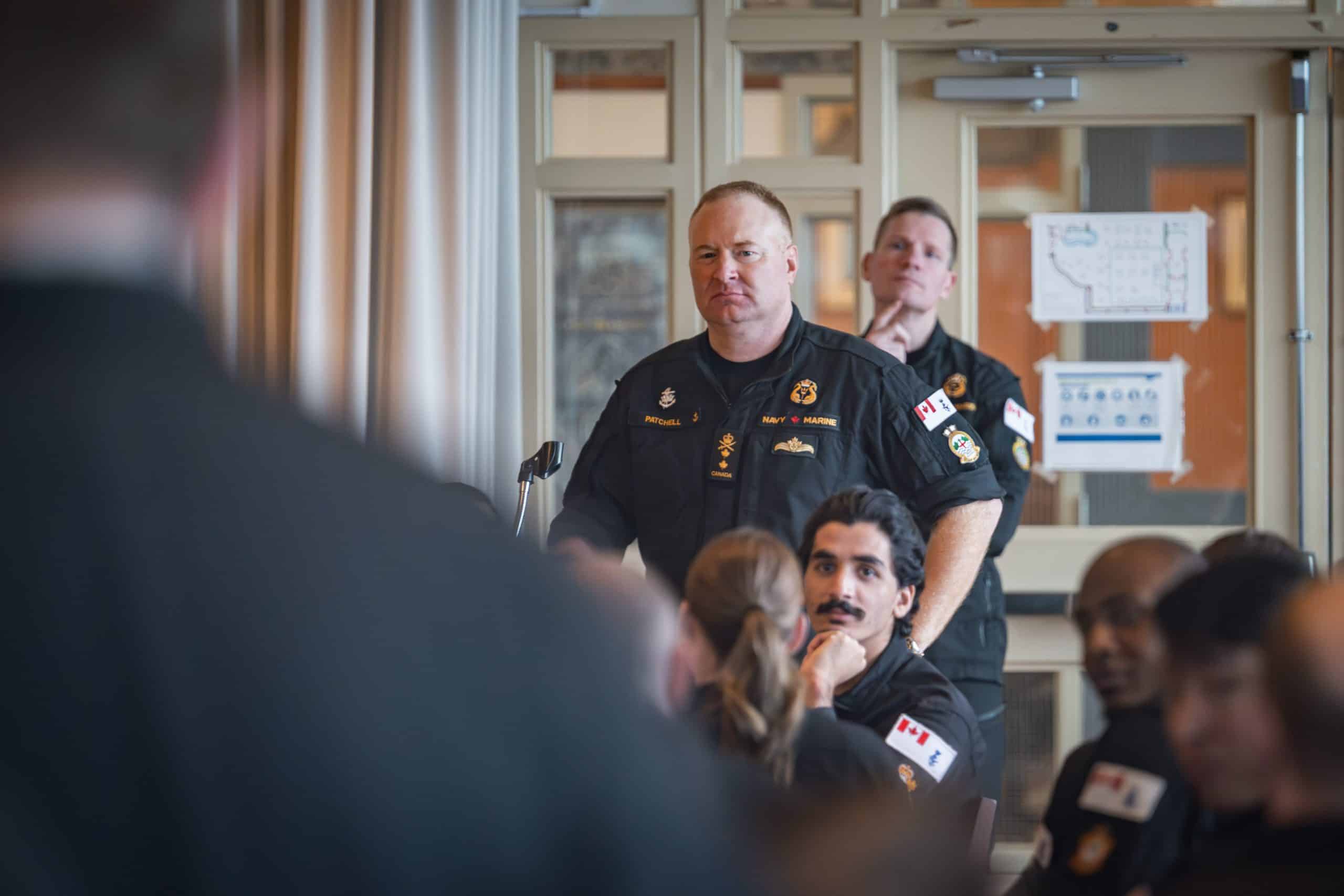
With the Royal Canadian Navy (RCN) currently short over a thousand sailors, Rear Admiral (RAdm) David Patchell, Commander of Maritime Forces Pacific (MARPAC) and Joint Task Force Pacific ( JTFP), walked into a Nov 19 town hall prepared to speak openly.
Hundreds of sailors packed the Rainbow Room at the Canadian Forces Base (CFB) Esquimalt’s Chief and Petty Officers’ Mess for the candid exchange. Split into two open question and answer periods (one for Junior Officers and another for Chief and Petty Officers), the town hall addressed topics ranging from new service vessels and infrastructure plans to personnel shortages, training bottlenecks, and daily quality-of-life concerns. RAdm Patchell opened the event by thanking sailors for their service during a period of operational demand and transformation, noting that the Navy “must grow two-and-a-half to three times our current size” to meet future requirements. RAdm Patchell also framed the town hall as an open forum, with a ‘no-holds-barred’ approach. He also emphasized three key future priorities for the Formation: defending Canada; regrowing and training the Navy; and inspiring professional warfighters.
RAdm Patchell then outlined major Defence investments, calling the progress of the National Shipbuilding Strategy “the most significant recapitalization in generations.” This includes the River-class destroyers, up to 12 new submarines, a future coastal corvette, additional Joint Support Ships, and up to 30 new training vessels. Locally, CFB Esquimalt is also preparing for extensive infrastructure renewal, including new housing, a new Nelles Block, an upcoming Alpha Jetty Recapitalization Project, a new submarine maintenance facility, and expanded warehouse. “In 15 years, this base will not look the same,” said RAdm Patchell. But readiness, he stressed, demands more than equipment.
RAdm Patchell and Formation Chief Petty Officer, Chief Petty Officer 1st Class (CPO1) Jonathon Sorensen, returned to the importance of collective professionalism, emphasizing how dress, deportment, and personal readiness as inseparable from operational credibility. “We’re not going back to yelling,” said CPO1 Sorensen. “But we are going back to standards.”
Questions from the floor reflected the daily pressures sailors face: difficulties prioritizing physical training (PT) time; administrative bottlenecks; innovation and fleet expansion; and rumours associated with the updated sea duty pay. RAdm Patchell reiterated the Navy’s intent, pending official policy approval, of $100 per sea day, whether at sea for a single day of training or on international deployment. Leadership also spoke to clear intent to increase frigate sea days, prioritise MARTECH sea experience, and avoid future skill/position gaps. He also addressed the recently announced military service pay backdated to April 2025, which is expected to reach members by the end of the fiscal year.
Sailors also pressed for clarity on deployment expectations and concerns that training pipelines were slowing due to staffing shortages, no-show rates, and security clearance delays. Leadership acknowledged these issues. CPO1 Sorensen noted that refresher training sees a 25 per cent no-show rate, impacting the ability to request expanded capacity. Meanwhile, RAdm Patchell highlighted progress at the security screening level, including the hiring of additional staff in Ottawa to improve security clearance wait times. However, it was cautioned that clearances will continue to take time, as the need for careful security is a top priority. Quality-of-life concerns were equally prominent at the town hall, with sailors raising questions regarding the scarcity of childcare in the Greater Victoria area, prompting an update on the upcoming 2026 Pacific Activity Centre at the Work Point Military Family Resource Centre.
Despite the scope of challenges raised, RAdm Patchell ended on a simple and optimistic note.
“This is a moment in time for our Navy,” he said, referring to the ongoing national surge of interest in the CAF and renewed federal investment in defence. “We need to train, retain, and inspire — and that starts with every single one of us.”