
Archana Cini, Lookout Newspaper
- Royal Canadian Navy (RCN) sailor Matt Blades survived over two hours in frigid Pacific waters after falling overboard from a RHIB near Vancouver Island, prompting an international, multi-agency rescue effort.
- The successful recovery highlighted the science, training, and coordination behind modern search and rescue operations, including drift modelling and functional time.
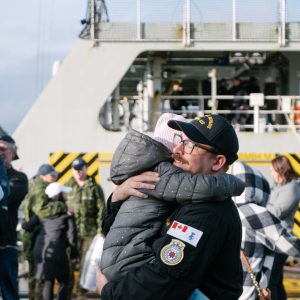
- S1 Blades met with rescuers and RCN leadership just five days later, with the meet leaving a lasting emotional impact on all involved.
–
One moment Sailor 1st Class (S1) Matt Blades was at the helm of a RHIB. The next, he was fighting for his life in the Pacific.
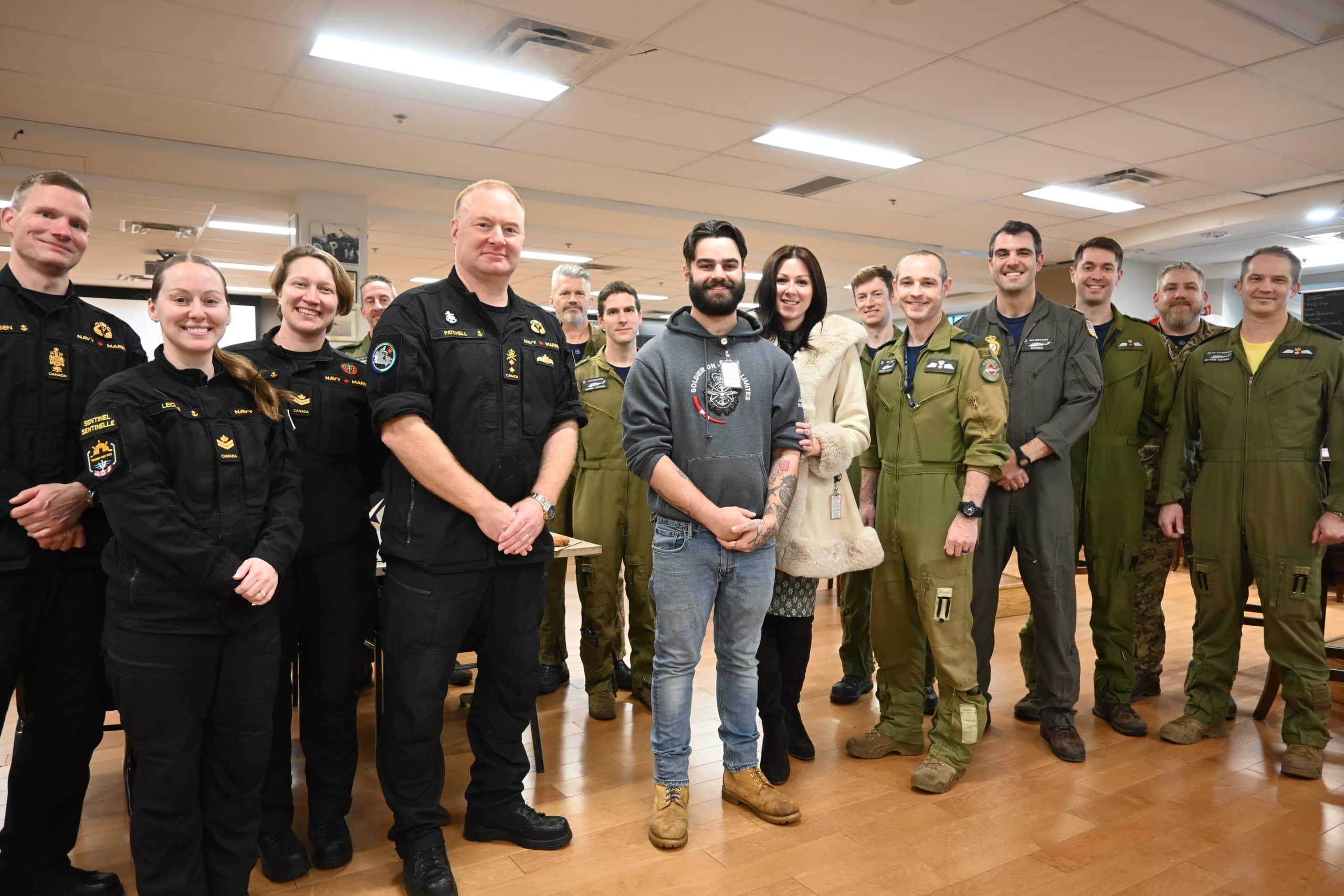
“My whole thought process was that they’re either going to find me, or there’s nothing else I could have done,” said S1 Blades. What followed was a rescue effort that left S1 Blades, his rescuers, and the local community with a deeper appreciation for training, teamwork, and the fragility of life at sea. S1 Blades and his wife S1 Margaret Blades also met some of his rescuers, Rear-Admiral (RAdm) David Patchell, Commander of MARPAC, and Chief Petty Officer 1st Class (CPO1) Jonathon Sorensen, to thank the team and share more about his experience — just five days after his near-death experience. The incident occurred east of Bentinck Island, where S1 Blades was operating a Rigid Hull Inflatable Boat (RHIB) as part of his sentry duties with a fellow sailor.
“The waters were getting pretty choppy, so I actually tuned the radio [on the RHIB] to channel 16 in case someone fell overboard,” said S1 Blades about the moments leading up to the incident. “Obviously, this was unknowing that it would eventually be me,” he laughed. S1 Blades fell overboard at approximately 2:40 p.m. into rough waters amid stormy conditions. “I was coming up over a wave when another one hit me and made me lose my balance,” he shared. “With that, I fell overboard and took the kill switch with me.”
The kill switch of a RHIB is a critical safety device intended to immediately stop the vessel’s engine if the operator is accidentally separated from the helm. This prevents a runaway vessel as well as potential accidents. However, S1 Blades was pulled from the RHIB and, given the day’s conditions and water currents, was unable to return to it.
At approximately 2:45 p.m., a mayday call was received by Search Mission Coordinator John Millman of the Joint Rescue Co-ordination Centre ( JRCC).
“I asked the sailor who made the call if he could see S1 Blades in the water,” said Millman. “He said, ‘No, I watched him go under.’ ” With more than 42 years of experience working for the Coast Guard and the Joint Rescue Co-ordination Centre, Millman then began to estimate where the RHIB could be located. To do this, Millman utilized the shape of the shore; current and wind information; and data from the caller to begin narrowing down a search location. “The person in the water is affected by the surface, which is affected by the wind, but not so much by the wind itself,” said Millman. “Knowing it was a very windy day and there was low visibility in the water, we conducted drift modelling and gave them [rescue teams] a sector search pattern to work with. Pretty soon, we actually had a sighting of the RHIB.”
The team searching for S1 Blades and the RHIB included: a CH-148 Cyclone helicopter; a Cormorant helicopter; His Majesty’s Canadian Ship (HMCS) Regina; an RCN Orca-class patrol vessel; a CC-295 Kingfisher aircraft; and the Canadian and United States Coast Guard. Once the RHIB was located, crews then began to search the area for S1 Blades.
At approximately 5 p.m., S1 Blades was spotted in the water by Major (Maj) Dennis Mann from the Cyclone aircraft — right in the middle of the estimated sector search pattern provided by Millman. “He [S1 Blades] was quite adamant to get my attention,” said Maj Mann. “It really was a full crew effort to get me to the right spot where I was able to see him. I just happened to be at the right side of the aircraft when we went by.” S1 Blades was then rescued aboard the closest vessel, the Pacific Guardian from Pacific Pilotage Authority, a civilian company boat that also responded to the mayday call, and immediately transferred to local emergency services. S1 Blades had spent over two hours in rough, frigid waters.
When asked what factors led to S1 Blades’ rescue, Maj Gregory Clarke from the JRCC said, “Ultimately, the JRCC doesn’t rely on luck.” “We approach a search and rescue (SAR) mission to the best of our ability with experience, tools, procedures, methods, manuals, and our crews,” said Maj Clarke.
“We use drift modelling, thermal cameras, infrared scanning, night vision goggles, and so much more when it comes to finding someone.” Millman and Maj Clarke also explained the concept of functional time. “Functional time is the time that someone can be expected to help themselves in a scenario like this. After accounting for what we thought S1 Blades was wearing and the conditions of the day, we predicted this to be 4.0 hours,” said Millman.
“How long we search for someone is at least twice, if not three times the functional time,” explained Maj Clarke. “So, we were prepared to search all night long — we weren’t even contemplating suspending the search by the time S1 Blades was rescued. Vessels were preparing to refuel and come back out on scene to search, something we call bingo time.”
Since the incident, S1 Blades has made a full recovery. For those involved, the rescue was a testament to the professionalism and detailed science underpinning modern SAR. From the sailor who made the mayday call to the coordinated tasking of multiple aircrafts and vessels, every part of the response was honed by training, technology, and teamwork.
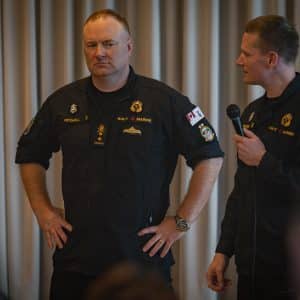
At the reunion, Rear-Admiral (RAdm) David Patchell, Commander of MARPAC/ JTFP, presented those involved in the successful SAR mission with a Commander MARPAC/JTFP Coin, thanking them for their service. “We owe you a tremendous amount of thanks,” he said. “We answer around 2,500 SAR calls a year, but there’s something different when it’s one of ours we recover. Thank you for saving a life this week.”
When S1 Blades was asked by RAdm Patchell if he had any fears about going back aboard a RHIB in the future, he replied, “Oh no, none at all.” The contrast is striking: S1 Blades’ rescue came just four months after a very different moment at sea — his July 2025 wedding to his wife S1 Margaret Blades, also conducted aboard a RHIB. Ultimately, this rescue will be remembered for its human impact: on the RCN sailor who survived, his loved ones waiting, and the rescuers whose dedication and excellence ensured he survived.
“Merry Christmas!” S1 Blades posted on Instagram on Dec 25 alongside a photo of him and his wife with RCN leadership and the rescue crew. “And thanks to those who made it so! God bless you all, to another year of doing our purpose!”