Archana Cini, Lookout Newspaper
-
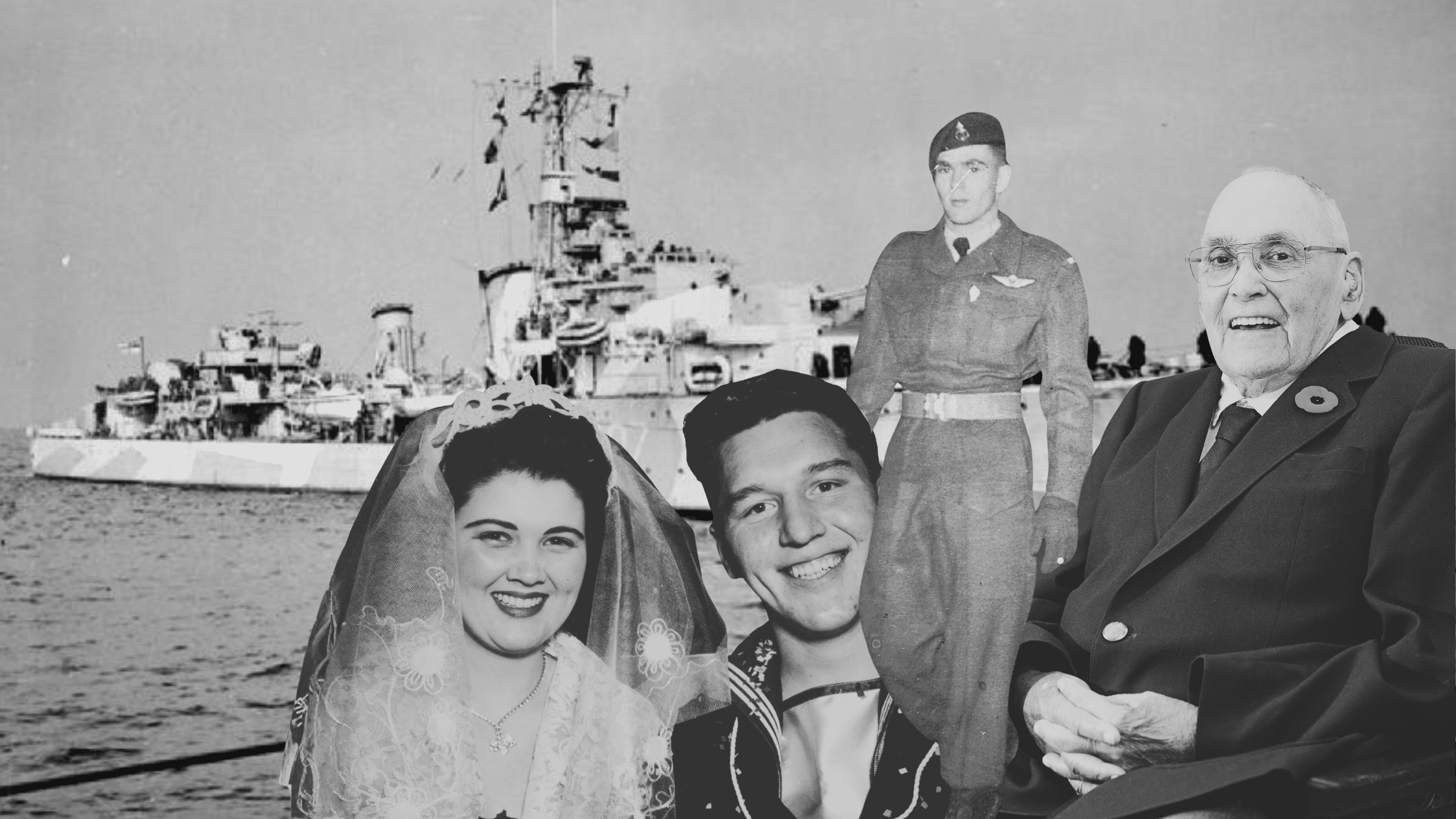
Three former Royal Canadian Navy (RCN) sailors who served together as teens during the Korean War reunited unexpectedly in their 90s at the Veterans’ Lodge, a Broadmead Care home.
-
The men shared memories of life aboard His Majesty’s Canadian Ship (HMCS) Athabaskan II, from demanding boiler room work to long months at sea.
-
Their reunion offered a powerful reminder of service, sacrifice, and the lasting bonds formed at sea.
–
For Roy Mackay, Gil Russell, and Don Russell, life in the Royal Canadian Navy (RCN) as teens meant hard work and discipline. Almost eight decades later, life would give them an unexpected gift — a sudden reunion of shipmates now in their nineties.
Now 92, 95, and 94 respectively, (Gil and Don are unrelated, and Don passed away shortly before being interviewed) the three reunited at Victoria’s Broadmead Care Society for the first time in decades. The last time they saw each other was when they were only 16, 18, and 19, serving aboard His Majesty’s Canadian Ship (HMCS) Athabaskan during the Korean War, a vessel often nicknamed ‘Athabaskan II’ or ‘Athabee’. A Tribal-class destroyer, Athabaskan II deployed on three wartime tours starting in 1950 with duties ranging from antisubmarine patrols to troop transport, evacuations, and bombardments. The vessel was in service to Canada from 1948 to 1966. Gil, Roy, and Don all deployed together during its third wartime tour, working as stokers in the boiler room.
“I was glad to get out of the army and into the navy, you know,” said Roy. “The navy actually helped me find a job during my return to civilian life, and that was really important to me.” Roy shared details of his work once aboard Athabaskan II for his first deployment with the RCN. “It was freezing down there in the boiler room, and there’d be three or four of us per watch, 24 hours a day. It was scary work and you’d just have to hope a mine, or the enemy, wouldn’t get you.”
Even the process of entering the boiler room was one of care and intent, with incorrectly done work potentially leading to serious consequences. “When you entered the boiler room, you had to remember to shut and lock the air lock behind you,” said Gil, recalling his duties aboard. “It was hundreds of pounds of pressure there. After a few minutes though, your body would begin to get accustomed to it, and you’d start work.” Gil also recalled the funnel, where those who were seasick and cold would huddle for warmth and relief during watch. “They were called high-speed boilers, what we would work on, and the ships would go around 42 miles an hour on the water. They were very efficient actually.”
Life aboard Athabaskan II was noted as rigorous and full of routine, with sailors sleeping in hammocks that would experience jarring vibrations whenever “the big guns” would be used. Beyond the boiler room and daily routines, the Athabaskan steamed long months at sea, rescuing downed pilots and transporting troops. Gil remembered how cold and disruptive seasickness could be, while Roy described heading ashore whenever they reached port to simply feel solid ground beneath their feet. “You get your feet on the ground; you’d order a beer,” he said with a grin.
After leaving the navy, both men built full lives ashore: raising families, working in civilian trades, and keeping the memories of their time at sea alive through stories. “I think I was the youngest there, at 18,” said Gil. “We’d all lay on the deck when we’d get seasick and look forward to our rum every day — 11:30 on the dot.”
Roy chuckled, adding, “We’d sing songs… don’t get too drunk!” Roy’s energy transitioned into his civilian life, with his enjoyment for songs morphing into a lifelong love for dance. For Gil, baseball became a passion.
“I changed,” Roy said thoughtfully when asked what service taught him. “It did also teach good hygiene,” he said, a joking answer that earned laughter all around the room. It was only after each of the three had independently moved to the Veterans Memorial Lodge, a Broadmead Care Home, that they learned they had served aboard Athabaskan II at the same time — a realization that sparked their recent reunion.
“It was something,” Gil said, reflecting on the connection decades later. “You don’t expect to find someone you served with half a century ago living in the same place as you, much less two men.”
While Gil continued to note that his memory was not what it used to be, his eyes lit up when describing his late wife. “Every day, I’d write a letter. It might not be long, but I’d write one to her. And then one day, we’d all get a whole stack back and try to control ourselves reading them all.” Roy nodded, remembering his own wife he’d also write letters with at the time.
When asked what it was like to see his love in person following his return home after the war, Gil replied simply: “To call it a special moment would be to call it nothing.”
When asked how they’d describe their service in three words or less, Gil responded with “proud of myself ” and Roy with “a good life.” Over 70 years after they first served together in the boiler room of Athabaskan II, Gil Russell and Roy Mackay sit side by side once again — not as stokers, but as men reflecting on lives shaped by service.
Written in memory of the late Don Russell, April 1, 1933 – Dec 16, 2025. Don was an RCN veteran who passed away after a life marked by hard work and service to Canada. Known for his dedication, resilience, and sense of humour, Don leaves behind a legacy of service and stories that will be fondly remembered for generations to come. As the men of Athabaskan II grow fewer, reunions like this become living history, moments where Canada’s naval past sits across the table, smiling and reminding us all what service once demanded and still represents.
Special thanks to Shannon Donnelly, Broadmead Care, for her contributions to this story.