A/SLt Jamie De La Chevrotière-Martin, MARPAC Public Affairs
-
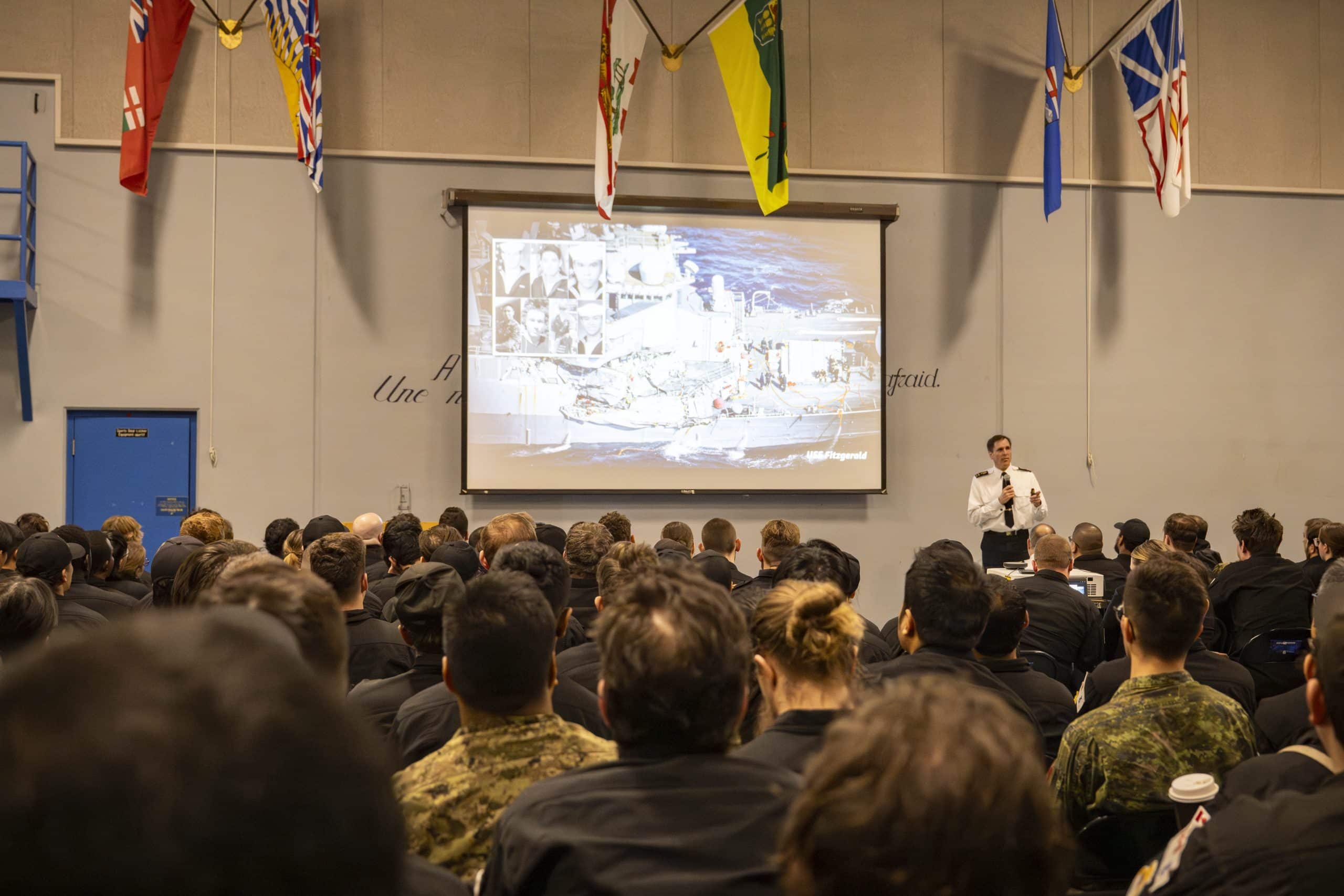
Vice-Admiral Angus Topshee, Commander of the Royal Canadian Navy, hosted town halls across both coasts outlining a frank view of today’s security environment and what the RCN must become.
-
He emphasized the need to strengthen maritime awareness to protect Canadian sovereignty, including building a unified maritime picture using sensors, autonomous systems, AI, and secure data-sharing.
-
VAdm Topshee also highlighted shipbuilding and industrial capacity, modernization, and faster personnel generation.
–
In a series of town halls delivered on both coasts, Vice-Admiral (VAdm) Angus Topshee, Commander of the Royal Canadian Navy (CRCN), offered a frank assessment of today’s security environment and a clear vision for what Canada’s navy must become. His starting point was blunt: the global climate has hardened.
While Canada’s 2017 defence policy, Strong, Secure, Engaged, emphasized a stable rules‑based international order, VAdm Topshee said today’s reality is increasingly shaped by power, interests, and competition. In that world, maritime forces matter and Canada must be able to defend its sovereignty. Despite readiness pressures and an aging fleet, VAdm Topshee noted the RCN has always maintained a strong global presence for a navy of its size. But the focus of the town halls was not on past achievements. Instead, he outlined what must happen next: improved maritime awareness; modern ships and submarines; faster and smarter personnel generation; and a culture focused relentlessly on competence, readiness, and war fighters.
MARITIME AWARENESS AND CANADIAN SOVEREIGNTY
Canada’s defining challenge remains geography. With the longest coastline in the world, three oceans, and vast maritime approaches, Canadians expect their navy to know what is happening on and under national waters. To close that gap, VAdm Topshee described a whole‑of‑government effort to build a single recognized maritime picture. This includes: the Coast Guard’s expanding surveillance mandate; partnerships with industry and researchers; and the use of seabed sensors, deployable systems, autonomous platforms, artificial intelligence, and secure data-sharing. The goal is persistent awareness from the seabed upward, so leaders can act quickly and confidently when required.
BUILDING SHIPS AND CAPACITY AT HOME
VAdm Topshee tied today’s modernization to Canada’s naval heritage, reminding audiences that the country has built ships at scale before. During the Second World War, vessels were constructed across Canada, and the navy pioneered major anti‑submarine warfare innovations, experience he says the RCN must return to as undersea threats grow. He framed the National Shipbuilding Strategy as more than procurement; it is a rebuilding of national industrial capability. VAdm Topshee mentioned Canada’s world‑class ship building facilities, acknowledged technical strengths while noting workforce challenges.
He also pointed to a timely opportunity to expand Canadian defence manufacturing as industries adjust to shifting trade and supply‑chain realities. The navy’s civilian workforce, particularly at Fleet Maintenance Facilities, was highlighted as a national strength, not only to sustain ships, but to rapidly adapt and convert commercial platforms and technologies into naval capability when needed.
FROM RECRUITING TO READINESS
On personnel, VAdm Topshee struck an optimistic tone. Recruiting is improving, training pipelines are being modernized, and programs like the Naval Experience Program are bringing new sailors into the fleet. Navy‑led basic training aligned with CAF standards will immerse recruits in the maritime environment from day one while supporting broader maritime skills for Canada.
The town halls ended with a sobering reminder: the sea is unforgiving. Accidents and combat alike punish mistakes instantly. Readiness, VAdm Topshee stressed, is ultimately about competence, accountability, and honesty about risk. As the Command Chief Petty Officer, Chief Petty Officer 1st Class Pascal Harel, reinforced, conflict may not be chosen, but the navy must be ready for it.