


Archana Cini, Lookout Newspaper.
Humans of CFB Esquimalt is a series dedicated to the people who form the West Coast Defence community. It captures unique stories of service, identity, learning, and living from both civilians and military members who work and move through the base.
If interested in sharing your story, please email archana.cini@forces.gc.ca.
–
While many people join the Royal Canadian Navy (RCN) early in their working lives, Acting Sub-Lieutenant (A/SLt) Mike Samuels joined at 49 years old after two decades at a desk job.
“I figured I had around 15 years left of a good, working life,” said A/SLt Samuels. “This country has been very good to me, I felt joining the Forces was an opportunity for me to give back – and add some excitement as well!”
A/SLt Samuels was born in Montreal, but soon after his family moved to Peterborough, Ont. Here, he was raised alongside his older sister by his father, a psychology professor at the local college, and his mother, a nurse. At 15 years old, A/SLt Samuels had the opportunity to attend Trinity College School, a boarding school in Port Hope. He then went on to study philosophy and history at King’s College at The University of Western Ontario. After graduation, A/SLt Samuels spent a little over a year teaching English in South Korea after deciding to broaden his perspectives on the world. After his return, A/SLt Samuels moved to Toronto, where he spent the next 18 years working in the telecommunications industry in Network Operations, during which he also got married.
“I didn’t hate my job,” said A/SLt Samuels. “But it simply wasn’t the kind of work that gave me the sense of purpose or satisfaction that I was looking for.”
At 47 years old, A/SLt Samuels applied to the Canadian Armed Forces (CAF) amid the COVID-19 pandemic. During the two years between his application and training, he took on short-term jobs at both Purolator and a Costco distribution centre to work on his feet and prepare for the demands of basic training.

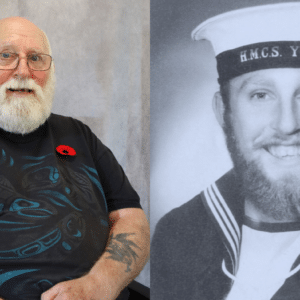
A portrait of A/SLt Mike Samuels. Photo: CPO1 Marc Lavoie
On his birthday, A/SLt Samuels received an offer of employment from the CAF. Shortly after, he began his Basic Military Officer Qualification (BMOQ) in August. He was the oldest in a platoon of about 60 candidates.
“From what I remember, there were two people who were in their 30s and 40s, and I was by far the oldest,” said A/SLt Samuels with a smile.
The physical side was where the age gap showed up most in his training. “A lot of the time, you’ve got a heavy pack on your back; you’re running with the rest of them; you need to keep up,” he said. “It was hard, I won’t lie. My knees and hips genuinely weren’t there at the start.”
Watching younger, fitter candidates perform past a standard he was struggling to hit did affect his esteem. “It wasn’t a sense of embarrassment or shame. It was really frustration, because you know you have to keep up, and you want it so badly,” said A/SLt Samuels. “By the end of training, I was proud to keep up.”
In addition to a fixed bar everyone had to clear, A/SLt Samuels shared how instructors also looked for candidates pushing 10 to 15 per cent past their own baseline, a criterion he was consistently able to meet both through his individual improvement and the joint efforts of those around him.
“If I had a huge pack on my back and I was on my knees needing to spring up, my platoon mates would help me out,” he said. “This sense of teamwork encouraged by the instructors was one of the most valuable lessons I learned moving through BMOQ.”
After successfully completing BMOQ and being posted to Canadian Forces Base (CFB) Esquimalt, A/SLt Samuels began training as a Naval Warfare Officer (NWO), a trade he describes as one of the most demanding in the RCN. Partway through the NWO4 training course, A/SLt Samuels sat down with his chain of command and made the difficult decision to leave the trade.
“NWOs are exceptional mentally, physically, and emotionally,” he said of his former colleagues. “At this stage in my life, being away from my family and still training and learning is tough. On the other hand, switching my trade allows me to support and serve right away, to the best of my ability.”
Similar to when he worked through his BMOQ, most of A/SLt Samuels’ fellow NWO trainees were half his age.
“We joke a lot, because some of them could have been my kids,” said A/SLt Samuels. It made a strange kind of camaraderie, he noted; one that was real, and full of understanding. He also shared that over the years serving in the RCN, A/SLt Samuels has learned to lean on all the people around him, no matter their age – just as they have learned to lean on him.
Today, A/SLt Samuels serves with the CFB Esquimalt Base Public Affairs Office to advance CAF/RCN awareness through communications outreach.
When asked what makes a good sailor, A/SLt Samuels thought of his own role before responding.
“Social media and the news tend to show the exciting side of naval service: missiles, helicopters, joint operations with allied navies. While this grabs attention, it’s not necessarily what makes a great sailor,” said A/SLt Samuels.
To him, a sailor is also defined by the moments no one sees.
“Standing watch through the night and staying just as alert and focused; catching the small things, when everyone else is asleep, and doing something about it; looking out for younger members and making sure they’re supported. To me, a good sailor holds themselves to high standards at all hours of every day,” said A/SLt Samuels.
Read more from Humans of CFB Esquimalt here.