
Lindsay Groves, Lookout Newspaper
Today, leadership carries many definitions and, at times, misunderstandings. It can appear to be a lot of certainty, command, and action — necessary qualities for any leader. Yet there are foundational elements of leadership that are often less noted, such as calmness, serenity, integrity, and courage.
Those are words used to describe Major (Maj) Dick Winters in the book Conversations With Major Dick Winters: Life Lessons From The Commander Of The Band Of Brothers by Cole C. Kingseed. Winters’ story was brought to life by Steven Spielberg and Tom Hanks in the HBO series Band of Brothers, which shared his experience in the Second World War and the hard-earned respect he earned as a leader. Winters, that book, and my work with the CFB Esquimalt community inspired this article — and I hope a series — because leadership is only a word until you witness it in action.
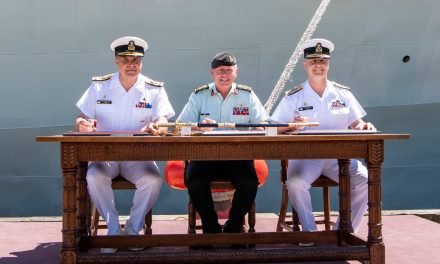
When I sat down with Rear-Admiral (RAdm) David Patchell, Commander of Maritime Forces Pacific (MARPAC) and Joint Task Force Pacific ( JTFP), to learn more about his thoughts on leadership, morale, and service, he was quick to redirect the spotlight.
“It’s difficult to talk about one’s own leadership,” said RAdm Patchell. “It’s much easier to talk about the amazing leadership I see around this formation.” On the bridge, across the base, at sea and at home, leadership is all around us.
“I was on board [His Majesty’s Canadian Ship] HMCS Regina this week,” he continued. “The way that the command team leads — absolutely impressive. The Commanding Officer (CO) Darren Sleen inspires his team by talking about the importance of things as simple as drills and writing them out. Everyone can go and read the CO’s philosophy and understand, in detail, why what they’re doing is important.”
RAdm Patchell also spoke to humility as a defining quality of leadership. “Humility gives one the openness to listen — to actually listen and to change course. If you are not humble, you will not listen. If you will not listen, people will not trust you.”
Trust, he emphasized, has never been more important as Canadians awaken to the reality that the world is a dangerous place. “We’re in competition,” he said. “We’re not in peacetime and we’re not in war time — we’re somewhere in between.”
This space in between demands more from all of us.
“Ego can be important,” said RAdm Patchell. “We need to be competitive. We’re the military, we need to win. There is no second place. We encourage competitiveness. How do you pair that with humility and understand where to apply either one? We never want to defer to an enemy, but I absolutely need to be humble enough to listen to my boss, to my peers, to every team member.”
When asked about the importance of morale, RAdm Patchell stated that morale is the will to fight. “What that means in MARPAC is the will to train every single day. It’s the will to recruit, and the will to be better than we were yesterday. The will to do more.”
He explained that morale is not the same as happiness. “We’re not seeking happiness. Though for the record, I want people to be happy. I want them to be content. I want them to have good lives. But happiness is not morale.”
There exists a powerful relationship between morale and trust, particularly in the training and preparation of warfighters. This trust is not abstract or rhetorical — it is forged through rigorous training and shared hardship and ultimately tested under the most demanding conditions.
“We need to continue to train properly, inspire, and trust. That trust is very difficult to build and very quick to lose.” These are words to carry into the days ahead with a responsibility to trust one another; to act with courage and integrity and to lead with the will to fight.
“From the brand-new Sailor 1st Class to the Captain,” said RAdm Patchell, “we are all leaders.”
And there is work to do.