

Archana Cini, Lookout Newspaper. Contributions by Capt Surbhi Matta, Combat Training Centre
-
Exercise ROUGISH BUOY 2026 brought CAF combat divers back to Vancouver Island for the third consecutive year, training at Albert Head and Whirl Bay’s Underwater Demolition Range.
-
First held in 1979, ROUGISH BUOY remains Canada’s only dedicated collective combat diver exercise, focused on operational readiness, recertification, and advanced underwater skills.
-
This year’s 47th iteration included multinational participation from the United Kingdom, Latvia, Germany, and the Netherlands.
–
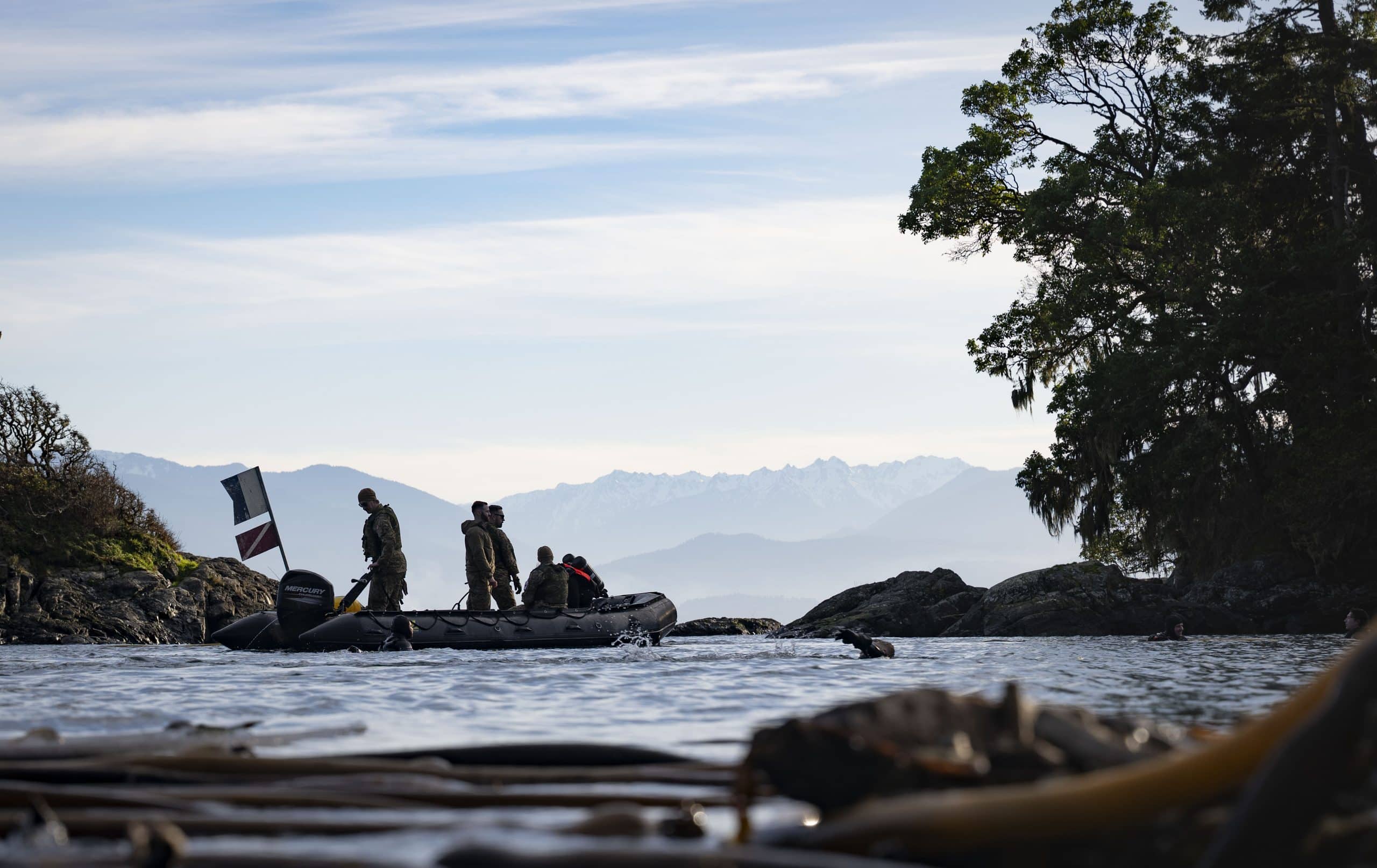
An uncommon sight greeted the Vancouver Island shoreline near Albert Head and Whirl Bay Underwater Demolition Range this January: that of Canadian Armed Forces (CAF) combat divers, suited, and sub‑ merged as they practised demanding underwater skills in the Pacific Ocean. Meet Exercise (Ex) ROUGISH BUOY 2026, Canada’s only dedicated collective training exercise that annually unites Canadian and international combat div‑ ers for diving practice, skill development, international cooperation, and dive recertification.
The history of Ex ROUGISH BUOY stretches back decades in Canadian history, with its first iteration held in 1979. The exercise was initially created to ensure that combat dive teams could annually maintain oper‑ ational readiness and proficiency for tasks that might be required while deployed, including underwater demoli‑ tion, reconnaissance, and obstacle clearance. Over the years, the exercise has rotated locations and grown to include participating nations. This shift began to foster cooperative learning and technical exchange in addition to holding Canadian combat divers to high operational standards.
This year’s installment saw divers return to Vancouver Island for the third consecutive year and the exercise’s 47th iteration.
Once at Whirl Bay, the training was challenging. Divers worked through underwater demolition scenar‑ ios, placing charges to clear obstructions prior to deton‑ ation. The exercise also covered underwater navigation; insertion and extraction techniques; and water to land transitions from swimming and diving to kayaking.
“During Exercise ROGUISH BUOY 2026, helocast‑ ing took place on January 29. The divers started with helicopter safety training alongside 443 Maritime Helicopter Squadron, just to make sure everyone was dialed in before moving to live inserts. The next day, divers were out at Albert Head conducting the casts just off the coast,” said Captain (Capt) Willis Ripley, Exercise Lead Planner and Lead Coordinator. “The training was progressive. They begin with the basics, just wetsuits and fins, working their way up to full diving ensembles. It all built toward the final step, which was inserting a boat and crew, followed by fully kitted divers jumping in from the helicopter. That progression helps build confidence and makes sure everyone understands the sequence before we add complexity.” said Capt Ripley.
With the sounds of demolition and flashing lights visible from nearby regions, leadership from Ex ROUGISH BUOY set shoreline restrictions near Whirl Bay and Bentinck Island through the duration of the exercise, which will conclude Feb 12. The exercise also utilized underwater bubble curtains to constrain marine shockwaves and protect wildlife in the nearby area.
“This training really matters because it gives our divers the chance to work directly with our allies, and sharpen the skills we rely on in real operations,” added Capt Ripley. “Every exercise is an opportunity to com‑ pare techniques, learn new approaches, and build the kind of trust you only get from working side by side.”
The multinational nature of this year’s exercise added an important layer of complexity — and opportunity — for divers. For Ex ROUGISH BUOY’s 47th iteration, CAF combat divers were joined by those from the United Kingdom, Latvia, Germany, and the Netherlands.
“My team was partnered with the Latvian dive team, who serve as the primary diving school for the Baltic countries. Their diving proficiency is exceptional, and there was a great deal we were able to learn from them; ranging from fundamental skills like buoyancy control to more advanced tasks such as complex underwater navigation,” said Warrant Officer (WO) Eric Laprade, Dive Team 2IC. “In turn, anything related to battle procedure, operat‑ ing in a tactical environment, and conducting recon‑ naissance remains a Canadian strength,” noted WO Laprade. “We were able to demonstrate these capabil‑ ities throughout the exercise. From delivering warning orders and developing plans to conducting briefs and executing tasks, these are areas where our teams excelled and were able to share valuable expertise.”
When asked what moments from ROUGISH BUOY 2026 stood out to him, Petty Officer 1st Class (PO1) Kimball Bishop, Port Inspection Diver, responded with “From an international perspective, getting the chance to exchange ideas with divers from allied nations was huge for us. Every country brings its own equipment, techniques, and ways of approaching the same mis‑ sion sets, so those conversations really broaden our understanding and help us improve how we operate. You pick up little things—different methods, different problem‑solving styles—that end up making you more capable in the long run.”
As these highly trained combat divers will continue to refine their underwater skills and expertise until Feb 12, annual and international exercises like ROUGISH BUOY ensure our Canadian force remains ready to approach the challenges of real-world operations.