
Archana Cini, Lookout Newspaper.
-
An annual memorial ceremony marks 81 years since the sinking of HMCS Esquimalt and honours 44 sailors lost.
-
Story highlights what followed the tragedy, including U-190’s capture and role in Canadian naval training.
-
Powerful examples of reconciliation show how remembrance often extends beyond loss and into shared humanity and legacy.
–
Almost 81 years after His Majesty’s Canadian Ship (HMCS) Esquimalt sunk within sight of the Canadian shoreline, members of the Defence community, local leadership, and island residents gathered in the Township of Esquimalt to remember the ship’s crew and reflect on something larger than the tragedy alone.
The annual ceremony marked the sinking of the Bangor-class minesweeper, torpedoed by the German submarine U-190 on April 16, 1945 — just weeks before the end of the Second World War in Europe.
Captain(Navy) (Capt(Navy)) Kevin Whiteside, Commander of Canadian Forces Base (CFB) Esquimalt, shared that the ceremony remains one of the most meaningful events he attends.
“This is one of my favourite ceremonies to be a part of because of how much it means to this township, and this base,” said Capt(Navy) Whiteside. “Though the events of 1945 grow distant in time, their meaning does not.”
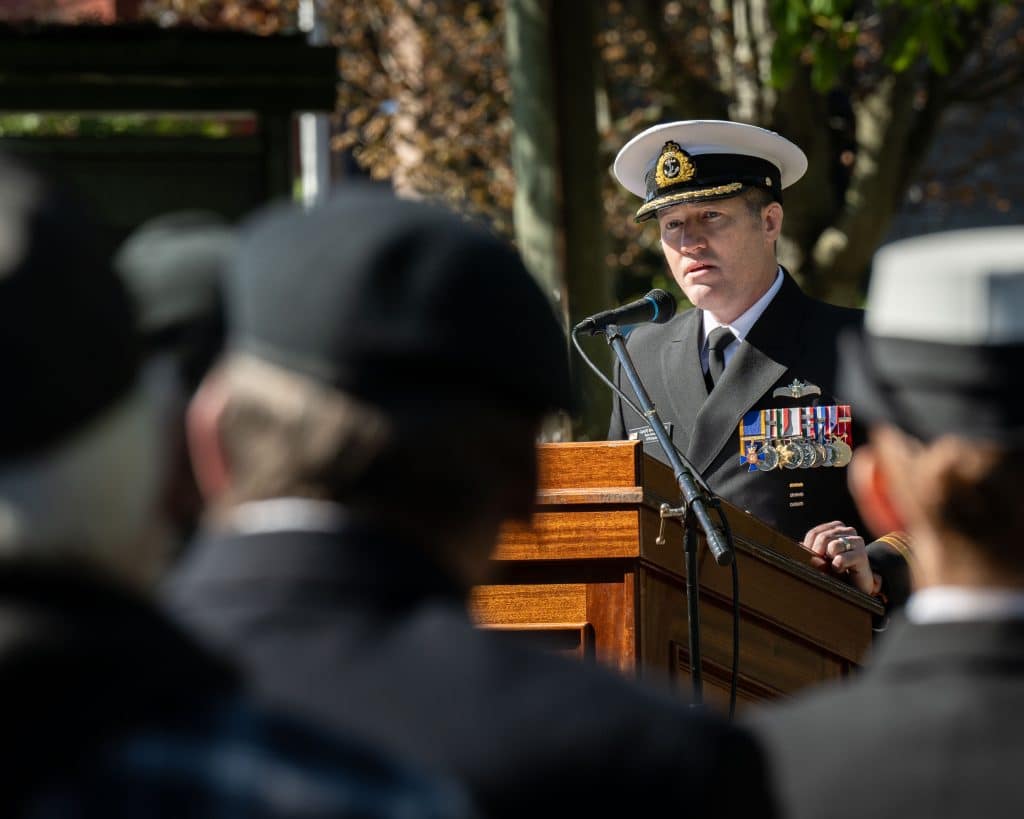
Captain(Navy) Kevin Whiteside, Commander of CFB Esquimalt, speaks during the HMCS Esquimalt memorial ceremony held on April 16.Photo: Cpl Conor R.G. Munn, CAF Imagery
Mayor Barbara Desjardins, who has spoken at the annual remembrance ceremony for the past 18 years, emphasized the deep connection between the Township of Esquimalt and the vessel that carried its name.
“The loss of HMCS Esquimalt is significant to the township, not only because she shares our name, but because we recognize the sacrifice and the loss of those who served on her,” she said. “Behind each of these men lost were families; wives, sons, daughters, parents, friends, and communities.”
On April 16, 1945, 44 lives were lost in what became the last Canadian warship to be sunk by enemy action during the war. Yet, history did not end there.
Following Germany’s surrender, U-190 received a transmission that it must surrender to Allied forces, after which it became a Canadian prize of war. The submarine was then commissioned into the Royal Canadian Navy (RCN) and participated in naval training exercises; testing and evaluations; and a St. Lawrence River tour. With this transition of ownership, a vessel that had once hunted Canadian ships and sailors now helped strengthen the operability of the Canadian Armed Forces. In this reversal of roles was a valuable learning: even instruments of war can be repurposed in service to peace, and history can carry forward in unexpected ways.
On Oct 27, 1947, U-190 was scuttled with live fire in the approaches to Halifax Harbour, in the same approximate position that it had sunk HMCS Esquimalt two years prior. The submarine’s periscope was also removed from its body and is now on display at the Crow’s Nest, St. John’s, a private club founded over 70 years ago for visiting and stationed Navy officers during the Second World War. Now, the club houses hundreds of rare Canadian naval and military artifacts.
However, remembrance is not only about loss; it is also about what people choose to build, afterward. Werner Max Hirschmann, chief engineer and second-in-command aboard U-190, later immigrated to Toronto following the war’s end. In the years that followed, Hirschmann consistently attended earlier memorial services in remembrance of HMCS Esquimalt, the very vessel he was involved in sinking. Poignantly, he did so alongside Canadian sailor Joseph Frank Wilson, one of the final few survivors of HMCS Esquimalt. Their joint attendance offered an enduring and powerful image of reconciliation — one of two men once divided by war, united decades later for the purpose of remembrance.
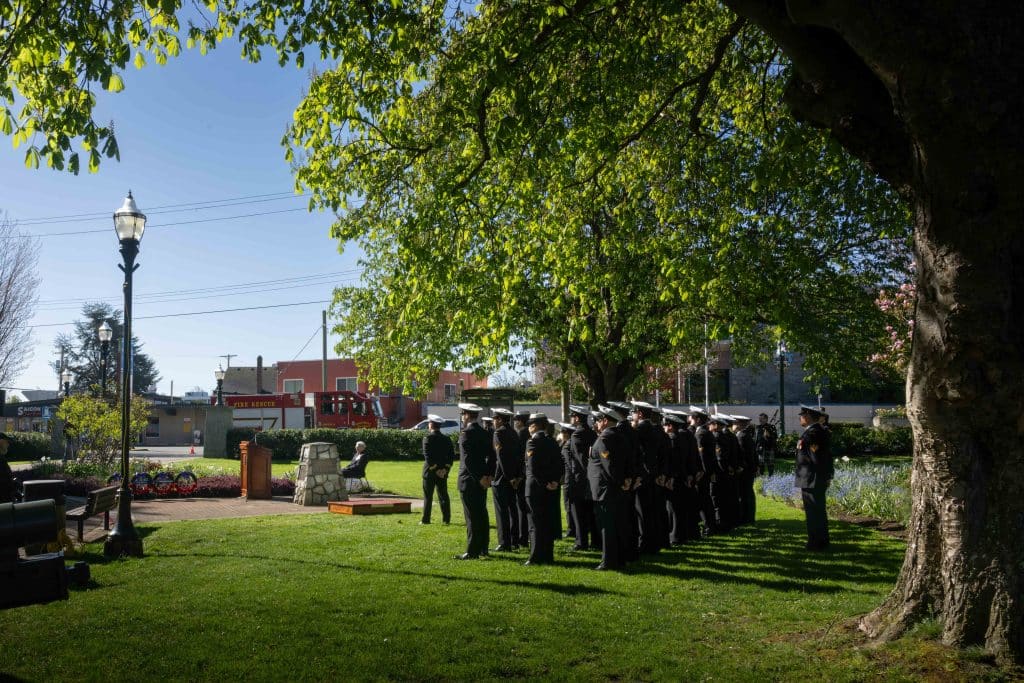
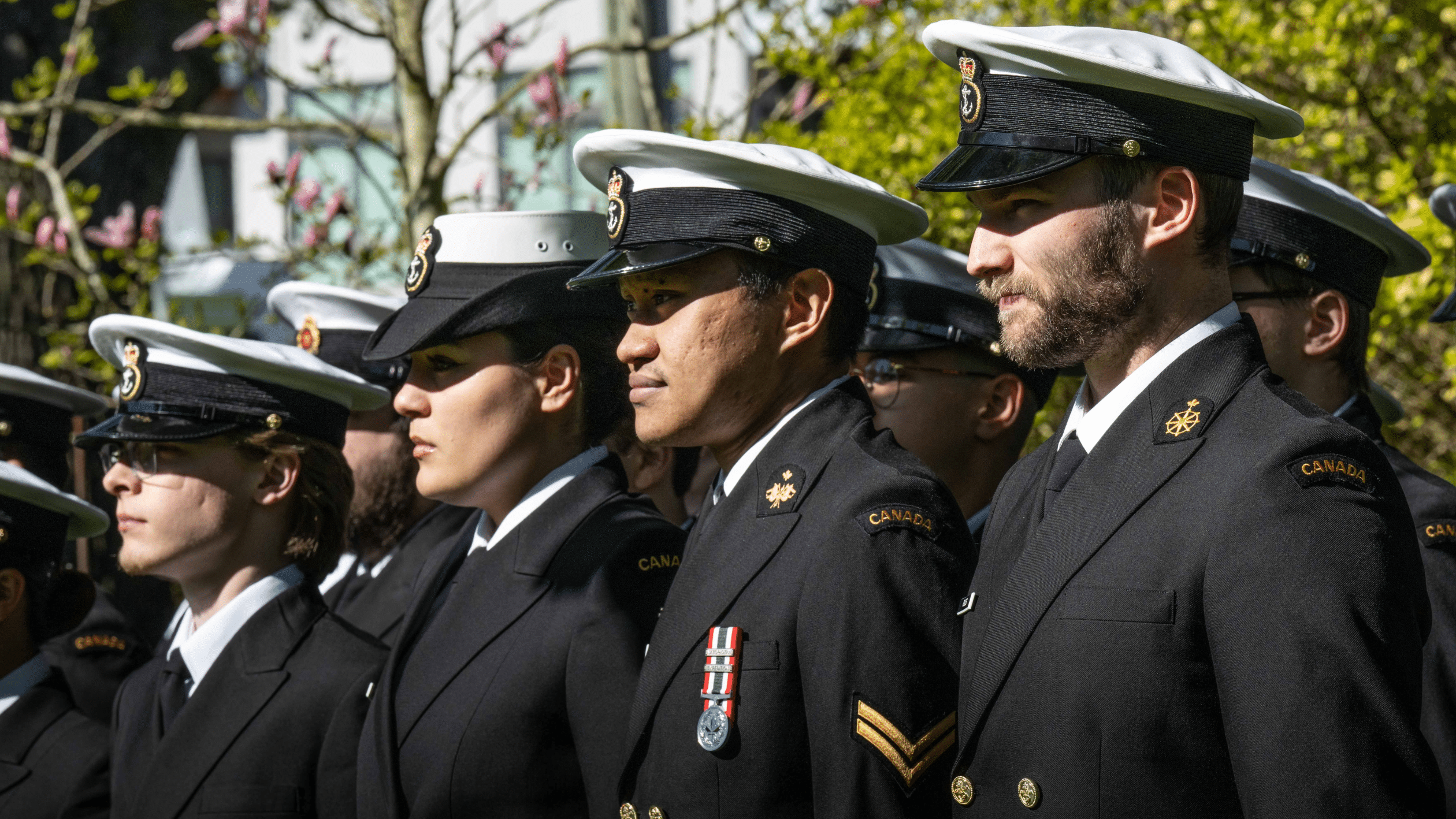
Members of the Defence community and local neighbourhood gather during the HMCS Esquimalt memorial ceremony held on April 16. Photo: Cpl Conor R.G. Munn, CAF Imagery
“Their shared presence bore witness to the powerful truth that even after war, there can be humanity, reconciliation, and peace,” said Lieutenant-Commander (ret’d) Gerald Pash, Master of Ceremonies, during the April 16 ceremony. “As such, our act of remembrance today is not only about the past; it is also about the future.”
Mayor Barbara Desjardins also pledged that the community would continue to gather each year, noting that “[with] their passing, it falls to all of us to carry the torch of remembrance.”
This is a torch that continues to burn, since that 1945 April morning, not only for those who sacrificed their lives, but also for those who continue to choose reconciliation in the years that follow.