


Archana Cini, Lookout Newspaper
-
Lt(N) Alistair Hirst stopped during his daily bike commute after noticing a crashed truck with flames under the hood.
-
Using his training and quick assessment skills, he helped extinguish the fire and supported the driver until help arrived.
-
The moment highlighted how RCN skills, preparation, and service mindset extend beyond the workplace.
–
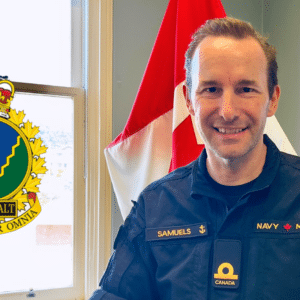
For Lieutenant(N) (Lt(N)) Alistair Hirst, a Bridge Watchkeeper with Patrol Craft Training Unit (Pacific) (PCTU[P]), his daily bike ride from Vic West to His Majesty’s Canadian (HMC) Dockyard is a familiar one. He commutes by bike most days, usually dropping his two children at daycare along the way before continuing to work. On July 21, Lt(N) Hirst was riding alone.
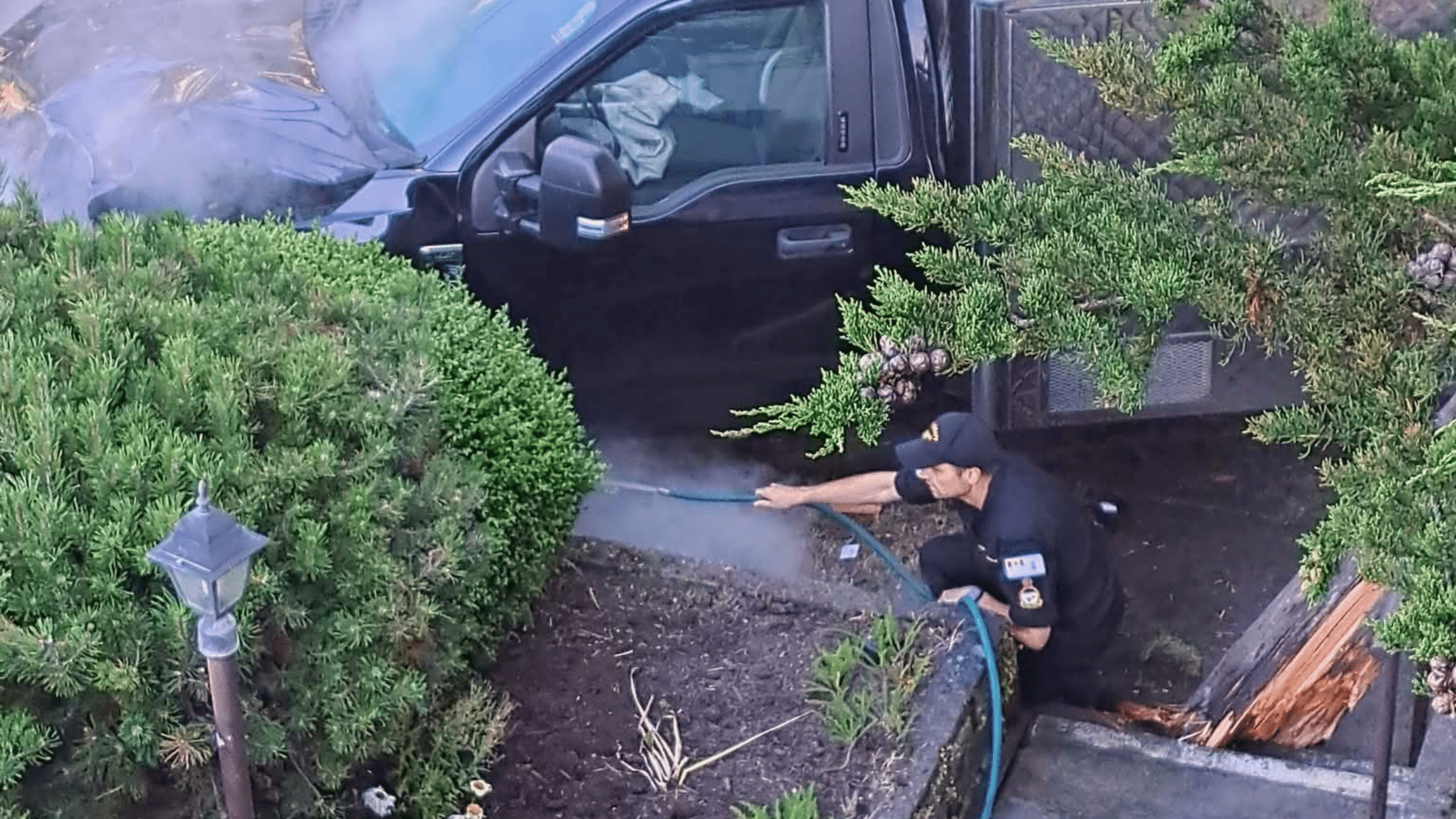
As he approached a nearby street, he noticed a truck that had crashed into a telephone pole.
“My first thought was that maybe it’s an accident that happened an hour ago and the emergency services have already taken care of it,” he recalled. But then he saw the smoke and the fire under the engine, and realized help hadn’t arrived yet.
Lt(N) Hirst immediately pulled over and assessed the scene, checking the damaged power lines and confirming that the truck was turned off before checking for casualties. He noted that the vehicle was empty and that the driver had been supported bystanders and was sitting nearby, shaken but talking and upright without visible injuries.
With the fire still burning under the hood and no extinguisher in sight, a man on a nearby apartment balcony pointed him to a garden hose. Immediately, Lt(N) Hirst unspooled it and doused the flames.
“It only took a few seconds to put out the flames,” said Lt(N) Hirst, though he later reflected that his priority could have shifted sooner to keeping bystanders clear of the damaged power lines.
For Lt(N) Hirst, stopping to help wasn’t really even a question he asked himself in the moment. “I can’t pass by someone in trouble and not stop,” he said, noting this wasn’t his first time arriving first at the scene of a car accident.
Lt(N) Hirst credits his Royal Canadian Navy (RCN) training for how he handled the moment, which was particularly timely as he had completed a Fire Refresher course just the week before.
“My training in the RCN absolutely kicked in, especially with the instinct to fight the fire as quickly as possible, but also more generally with the ability to stop and think my way through an intense situation.”
It’s a fitting reminder that training doesn’t stay at the base; it comes with you, ready to make a difference. Bravo Zulu, Lt(N) Hirst!