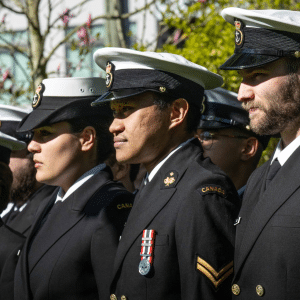
Lt(Navy) Kayvan Aflaki, Lt(Navy) Raymark Bancolita, and SLt Francesco Dinatale, Royal Canadian Navy
-
RCN Naval Warfare Officers joined the Canadian Lifeboat Institution during the Pacific herring spawn to support SAR operations.
-
Crews responded to real-world emergencies, including a high-risk nighttime medical evacuation at sea.
-
Experience reinforced shared values of leadership, teamwork, and service across military and civilian mariners.
–
As Naval Warfare Officers serving aboard His Majesty’s Canadian (HMC) Ships Calgary and Vancouver, our careers have largely involved sailing Canada’s territorial waters in support of maritime security and sovereignty. For the first two weeks of March, our post would be aboard a different vessel and in a different role; we joined the Canadian Lifeboat Institution (CLI) as part of a crew assigned to provide search and rescue (SAR) support during the annual Pacific herring spawn.
Our platform was the Delta Lifeboat, operating under the command of John M. Horton, O.B.C., C.S.M.A. Mr. Horton, a British-born Canadian mariner and Royal Navy veteran, has been nationally recognized for his decades of volunteer rescue work with Royal Canadian Marine Search and Rescue and the CLI. His work as an artist has similarly documented Canada’s maritime heritage.
Under Horton’s leadership, the Delta has assisted countless mariners across the Southern Gulf Islands and Sunshine Coast. Each spring, however, the Pacific herring spawn brings a particularly intense operational tempo. Female Pacific herring deposit millions of eggs on eelgrass and kelp while males release milt to fertilize them, turning the water a distinctive turquoise. The spawn triggers one of the coast’s most important ecological events as seabirds, sea lions, and other marine life converge to feed. First Nations have relied on and managed the spawn for generations using sustainable practices to preserve the stock. With the arrival of commercial fishing fleets, the spawn has morphed into a far busier and more volatile scene, making a dedicated SAR presence increasingly important.
We were welcomed by the CLI team in Ladner on March 1. That evening, we were notified of fishing activity south of Comox. Our crew hastily stored the ship and charted a navigation plan before casting off. With the Fraser River behind us, we transited north into the Strait of Georgia in the last light of evening. By the time we reached the waters around Denman and Hornby Island, signs of the spawn were already visible. Fishing vessels clustered along the coastline; seabirds dove relentlessly as they wheeled overhead in dense flocks. The waters south of Comox and north of Nanaimo would be Delta’s area of responsibility for the next two weeks.
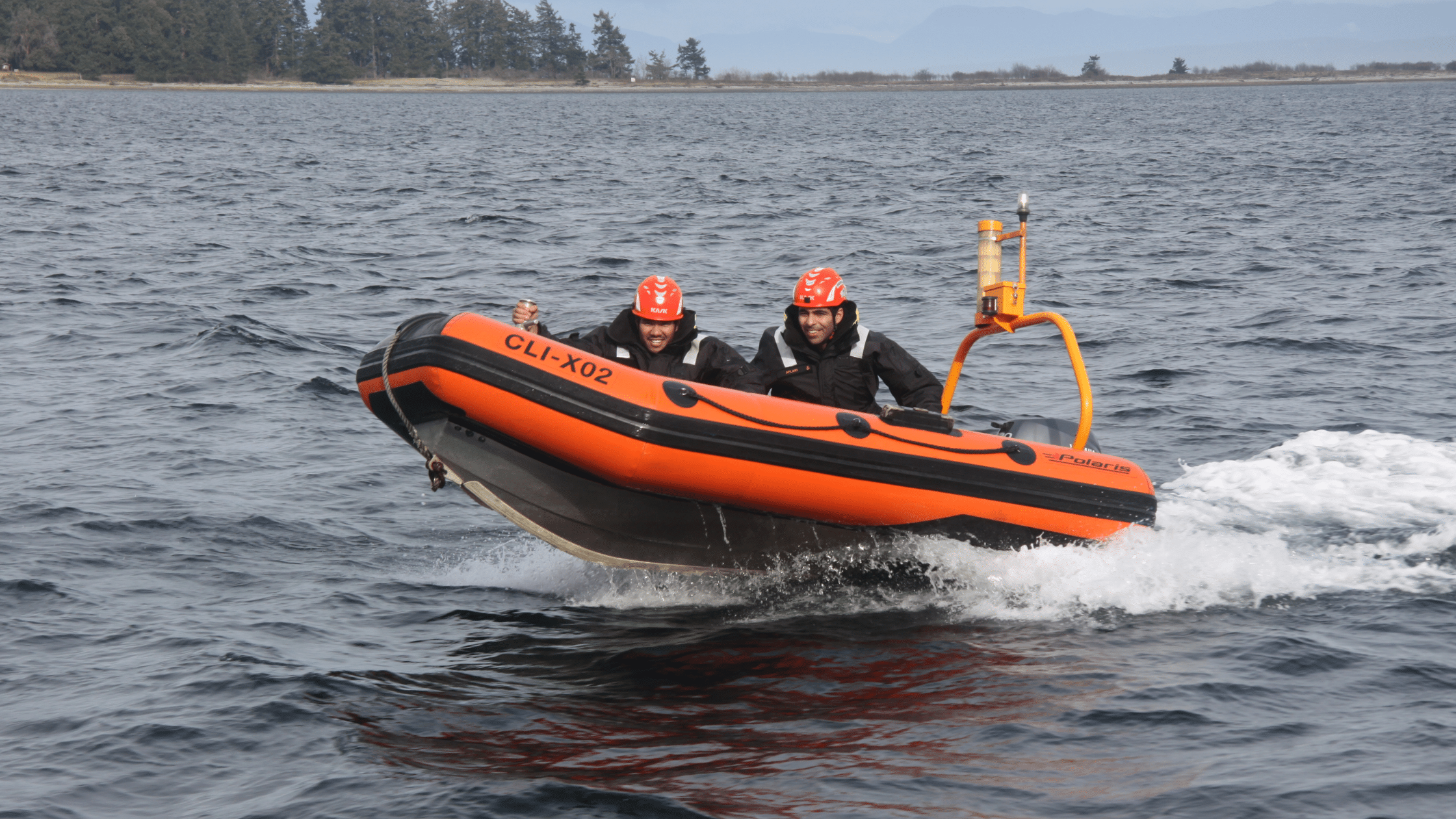
We learned quickly that the fundamentals of seamanship are universal. Akin to operating on the bridge of a warship, a firm understanding of navigation; disciplined watchkeeping; and teamwork are all common principles needed to lead the bridge aboard Delta. Indeed, we navigated, conned, and helmed the Delta during patrols, piloting it along the rugged British Columbia (B.C.) coastline and adhering to the International Regulations for Preventing Collisions at Sea. SAR operations, however, have a peculiar rhythm. Most of the time it is quiet. Time is spent scanning the horizon and monitoring movement of the fishing fleet. Often it is also spent listening to the steady background chatter of marine radio traffic, knowing that at any moment the calm can give way to urgency. During such quieter moments, Mr. Horton and the Delta’s team, which was comprised of veterans of the Royal Navy and Royal Dutch Navy, shared their knowledge of deck evolutions and ship husbandry. As members of the ship’s company, we dropped and weighed anchor; handled lines; launched, recovered and operated the ship’s Rigid-Hulled Inflatable Boat (RHIB). We also learned how to conduct search patterns and identify and tow vessels in distress.
The Delta responded to several calls for help, ranging from fishing vessels experiencing mechanical failure to mariners in medical distress. It was not until the late evening of March 10 that we were tasked by the Joint Rescue Coordination Centre (JRCC) to respond to a semi-conscious fisherman north of Hornby Island. Battling a tumultuous sea state, we navigated toward the co-ordinates and identified the gillnetter. We boarded the vessel as the Delta and gillnetter pitched violently beneath us, strapped the distressed fisherman to a clamshell stretcher and conducted a medical evacuation (medevac), transferring him safely to the Delta to receive care. With a crew member of the Delta, we began administering first aid for his hypothermia before rendezvousing with the Canadian Coast Guard (CCG) vessel Cape Cockburn to enact another patient transfer for advanced medical care.
The medevac, and our attachment to the Delta more broadly, reminded us that leadership extends beyond the traditional confines of naval warfare. Whether on the bridge of a frigate or the deck of a lifeboat, responsibility remains the same: to make sound decisions; support your team; and safeguard those in your care. Working alongside the volunteers of the CLI reinforced that the principles guiding naval service — professionalism, discipline, and service before self — are shared by those who stand watch over Canada’s waters every day.