
Archana Cini, Lookout Newspaper. Contributions by Robert Fisher, Historian, and the CFB Esquimalt Naval and Military Museum
-
An upcoming public ceremony on April 16 will mark 81 years since the sinking of HMCS Esquimalt, the last Canadian warship lost in the Second World War.
-
The ship was torpedoed off Halifax in 1945, resulting in the loss of 44 sailors, many to exposure while awaiting rescue.
-
The annual remembrance honours those who served and underscores the lasting impact of war on Canadian communities.
–
Each year, remembrance asks something of us. It invites us to pause, to reflect, and to carry ourselves with knowledge of the sacrifices and stories that might otherwise fade with time.
At 10 a.m. on April 16, remembrance will once again take shape as members of the Defence community and public are invited to gather in honour of His Majesty’s Canadian Ship (HMCS) Esquimalt, the last Canadian warship lost to enemy action in the Second World War. Organized by the Township of Esquimalt and supported by Canadian Forces Base (CFB) Esquimalt, the ceremony will mark 81 years since the ship’s sinking and pay tribute to the sailors who never came home.
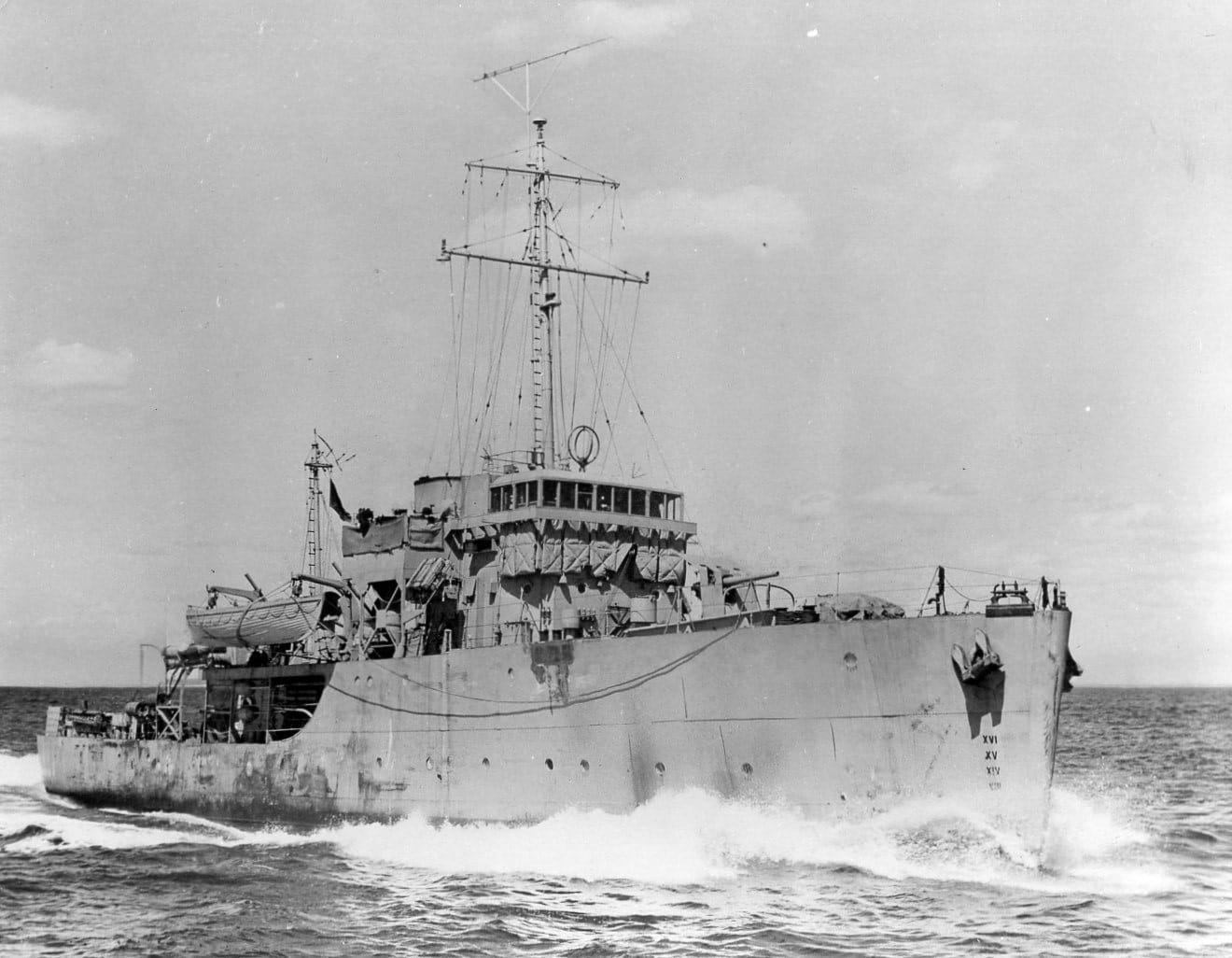
HMCS Esquimalt was a Bangor-class minesweeper, one of many vessels tasked with the vital and often dangerous work of keeping sea lanes safe during wartime. Armed with a 12-pounder gun, anti-aircraft weapons, and depth charges, Esquimalt was built for the constant vigilance required during the Battle of the Atlantic. The ship’s crew, comprising seven officers and 64 sailors, included many members of the Royal Canadian Navy Volunteer Reserve (RCNVR).
On the morning of April 16, 1945, Esquimalt was conducting an anti-submarine patrol just five miles off Chebucto Head, near Halifax. The war in Europe was nearing its end; for many, the worst seemed to be over.
But at 6:30 a.m., that sense of distance from danger changed. A torpedo fired from German submarine U-190 struck Esquimalt’s starboard quarter, ripping open its hull. The explosion instantly knocked out power, leaving the crew unable to send a distress signal. Within four minutes, HMCS Esquimalt had sunk into the Atlantic Ocean. What followed for the crew were cold, desperate hours spent waiting for rescue just within sight of shore.
Survivors scrambled into lifeboats and Carley floats, overcrowded and exposed. Some clung to the sides while others treaded water in the freezing ocean. Though an aircraft passed overhead just ten minutes after the attack, those in the water were mistaken for fishermen. Though attempts to contact the ship by radio failed, the urgency of the situation went unrecognized for hours. As time stretched on, sailors began to succumb to exposure. By the time rescue finally arrived, six hours after the torpedo strike, the human toll had deepened. 28 sailors are believed to have died in the initial attack. After the explosion, 16 more perished in the cold awaiting rescue. Of the 71 crew members aboard HMCS Esquimalt on April 16, 1945, only 27 survived.
The sinking of HMCS Esquimalt is remembered not only for its tragic loss of life, but for what it revealed about the cost of war. The Second World War was not a distant battle fought in far-off waters across the world. It happened within sight of Canada’s coastline. It was a stark and sobering reminder that war touched home — that it reached Canadian shores, Canadian families, and Canadian communities.
This is why remembrance matters. Even when we have not seen it or heard it or lived in its time, war affects us; it changes us; and stays with us, generation after generation, long after the sacrifice has been made. The HMCS Esquimalt memorial cairn, located at 1200 Esquimalt Rd, stands as a reminder of this. Here, in the centre of Memorial Park in the township that shares the ship’s own name, the story of HMCS Esquimalt is anchored in stone.
On the cairn, names of those who served aboard HMCS Esquimalt are remembered, and sacrifice is acknowledged. Importantly, the ongoing passage of time is met with a deliberate, tangible act of remembering that cannot wear away.
This is where HMCS Esquimalt and the ship’s company will be remembered on April 16. It will be 81 years to the day Esquimalt was sunk so close to Canadian shores, and the resolve to remember remains as strong as the details of the events of that day.
We hope to see you there.