

Archana Cini, Lookout Newspaper.
Humans of CFB Esquimalt is a series dedicated to the people who form the Canadian West Coast Defence community. It captures unique stories of service, identity, learning, and living from both civilians and military members who work and move through the base.
If you are interested in sharing your story for a feature, please email archana.cini@forces.gc.ca.
–
Some people move through their life belonging entirely to a single world. Reservist and artist Sailor 1st class (S1) Sabrina Holmes has always existed in two.
S1 Holmes grew up in Whitby, Ontario, far from the salty sea she now works near. However, water has always been a part of her life. S1 Holmes’ parents met through the Naval Reserves at His Majesty’s Canadian Ship (HMCS) York, where they served as marine engineers. Stories of sailing aboard gate vessels (naval training ships that opened and closed anti-submarine nets in major harbours to allow vessels to pass) and time spent at sea were never abstract; they were family history.
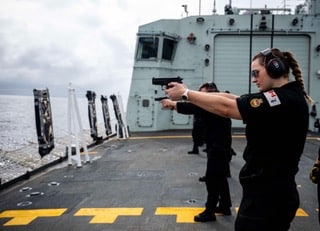
S1 Holmes’ childhood was also shaped by water. She learned boating skills and rope work early by her father, and spent years in competitive swimming building comfort and safety around water. Eventually, that connection to the sea became something more than background — it became a path. At 16 years old, S1 Holmes joined HMCS York as a Naval Reservist. However, she also found herself gravitating towards another subject throughout her upbringing: art.
“I was always more inclined at school towards art class, and really focused my skill acquisition towards drawing for years,” said S1 Holmes. “When the time came to start looking at university, my parents encouraged me to explore applying to some fine arts programs as it would very likely make school more interesting.”
Since then, she has balanced her academic years in uniform with summers spent serving across Canada’s coasts — a balance, however, that has never been simple.
“It’s not the workload that’s hard,” explained S1 Holmes. “It’s existing socially in both spaces.” In art school, she often found herself navigating assumptions about her military service.
“Art school largely has its predetermined opinion of the military and I really struggled to talk about it. Students and sometimes professors sometimes assumed the worst,” she said. “It could even become hostile.” In contrast, within the navy, she sometimes encountered confusion about her studies and artistic life. Over time, she learned to move carefully between both identities.
“I became very aware that these two spaces seemed to contradict each other,” said S1 Holmes. But slowly, what could have been a divide became something else entirely: a bridge she began to build.
“I accepted that the two worlds are as they are,” shared S1 Holmes. “To be in one does not exclude me from the other, so long as I take pride in the way I conduct myself and allow people to not understand, I will be okay. Being a bridge is tough, but ultimately, someone has to do it.”
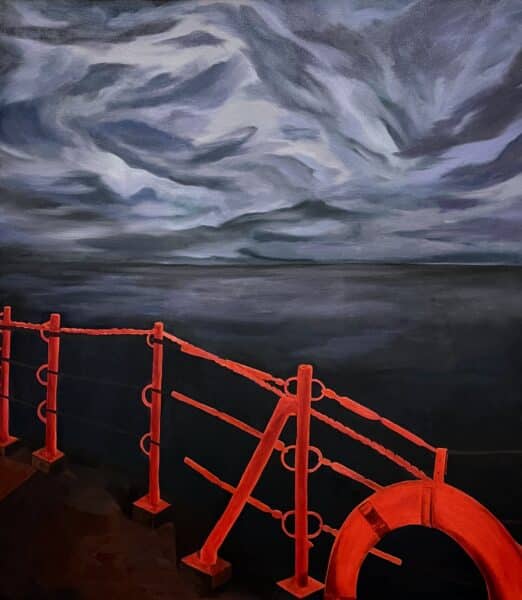
This balance, between land and sea and the worlds S1 Holmes was determined to coexist in, came into sharp focus during her time at sea. During a year-long attachment posting with HMCS Regina, S1 Holmes found herself documenting more than she expected. The ocean became both a workplace and a subject.
“Sailing for long stretches of time can be extremely isolating if you let it. Though we find ways to connect with our peers, working with people who don’t paint made this tougher for me. Interestingly, this forced me to be an artist when I was chronically away from art,” said S1 Holmes.
At sea, S1 Holmes spent free time planning new work, taking reference photographs, and returning to drawing. Importantly, those reference photos, often taken instinctively by sailors capturing fleeting moments of sky and water, became the foundation of her final thesis project.
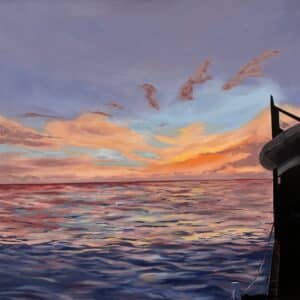
The result? Wash Your Heart, an eight-piece series of large-scale oil paintings, each approximately 4×4 feet. Created over nine months of near-daily studio work, the pieces are based on her lived experience at sea. The scale of the works was intentional. Cropped and immersive, they are designed to place viewers on the ship itself — to stand, in a sense, where sailors stand, and see what they see.
“I wanted people who aren’t in the Navy to feel like they’re being let into it,” she explained. “And I wanted people who are in it to feel represented.”
To S1 Holmes, the series is both storytelling and documentation. To those who serve, her work is documentation; for others, it’s a story. “But both are equally important,” said S1 Holmes.
Looking ahead, S1 Holmes hopes to continue both her naval career and her artistic practice, ideally in tandem with time at sea. “I don’t think this work is done yet,” she said. “I work with what opportunities I have in front of me. That’s the human experience I’m in right now.”
For those in uniform who carry creative ambitions of their own, her advice is simple. “The military can be your how,” said S1 Holmes. “But let your creative passion be your why.”