

Archana Cini, Lookout Newspaper. Contributions by Master Sailor Connor Nijsse, USAR
-
CFB Esquimalt’s USAR team completed a 10-day rope rescue and confined space course toward NFPA 1006 certification.
-
Training across multiple real-world locations built adaptability, problem-solving, and technical rescue skills.
-
The course strengthens MARPAC’s emergency response readiness in complex and high-risk environments.
–
Performing rescues from high atop the mast of His Majesty’s Canadian Ship (HMCS) Calgary, members of Canadian Forces Base (CFB) Esquimalt’s Urban Search and Rescue (USAR) Team put their skills to the test.
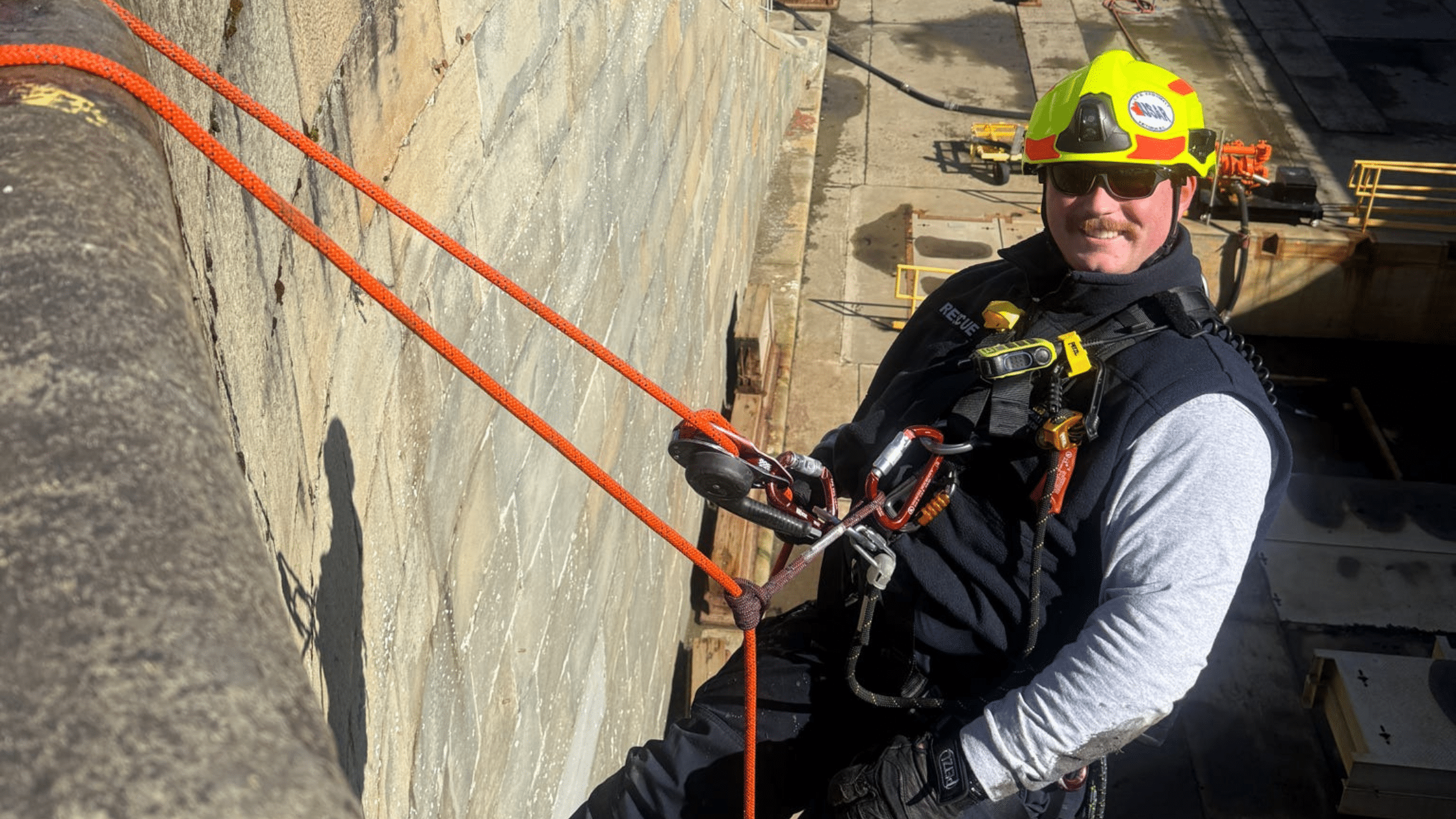
Over 10 days, eight members of the team completed an intensive Rope Rescue and Confined Space course, working toward National Fire Protection Association (NFPA) 1006 certification. The training, delivered in partnership with civilian agency Ronin Rescue, marked a focused opportunity to sharpen a critical capability within the team’s broader disaster response skillset.
Supported daily by two civilian instructors and military personnel gaining on-the-job experience alongside them, the training saw participants progressing through multiple certification levels while also building competency in confined space operations. Training took place across six different locations, including Fleet Maintenance Facility’s (FMF) dry dock and HMCS Calgary, exposing participants to a range of real-world scenarios.
“A key element to our rescue training is providing participants with multiple different locations, scenarios, and instructor experiences,” said Master Sailor (MS) Connor Nijsse, Logistics Chief at the CFB Esquimalt Medium USAR Team. “Often, rescue training is conducted in familiar places, which can lead to complacency. This course gave members the chance to learn from seven different instructors and work in unfamiliar environments.”
Cold, wet conditions added another layer of difficulty to these unfamiliar environments, particularly during high-angle evolutions on ship structures.
“It can be quite cold in the rain up the ship’s mast,” noted MS Nijsse. “But that’s part of the reality — we need to be ready to operate under any conditions.”
Beyond its physical demands, the course also emphasized problem-solving and flexibility. Rather than relying on a single rescue method, students were introduced to multiple techniques and methods all intended to accomplish similar tasks, building a more comprehensive understanding of rope rescue.
“The goal is for each member to not only accomplish the task, but understand the principles behind it,” said Nijsse. “Real-life rescue is rarely identical to training, so having a broad ‘toolbox’ to draw from is critical. You can really see when it starts to click for students… this progression is what we’re looking for, and it’s what makes the training so valuable.”
While rope rescue is just one component of the USAR team’s overall capability, the skills gained during the training are widely applicable.
“The knowledge from rope rescue can then be applied to tasks like moving heavy debris, accessing confined areas, or reaching casualties quickly,” said MS Nijsse. “Having a fully capable rope rescue team made up of military members is a strong asset for the Maritime Forces Pacific (MARPAC).”
With this being the second iteration of the rope rescue course since 2024, the team hopes to maintain the ongoing tempo of training. As CFB Esquimalt continues to strengthen its emergency response capabilities, exercises like this ensure that when called upon, Defence team members are ready and equipped to respond.
For more information concerning the base USAR team or joining, please email P-ESQ.MUSAR@forces.gc.ca.