
Lookout Newspaper Logo

Latest News

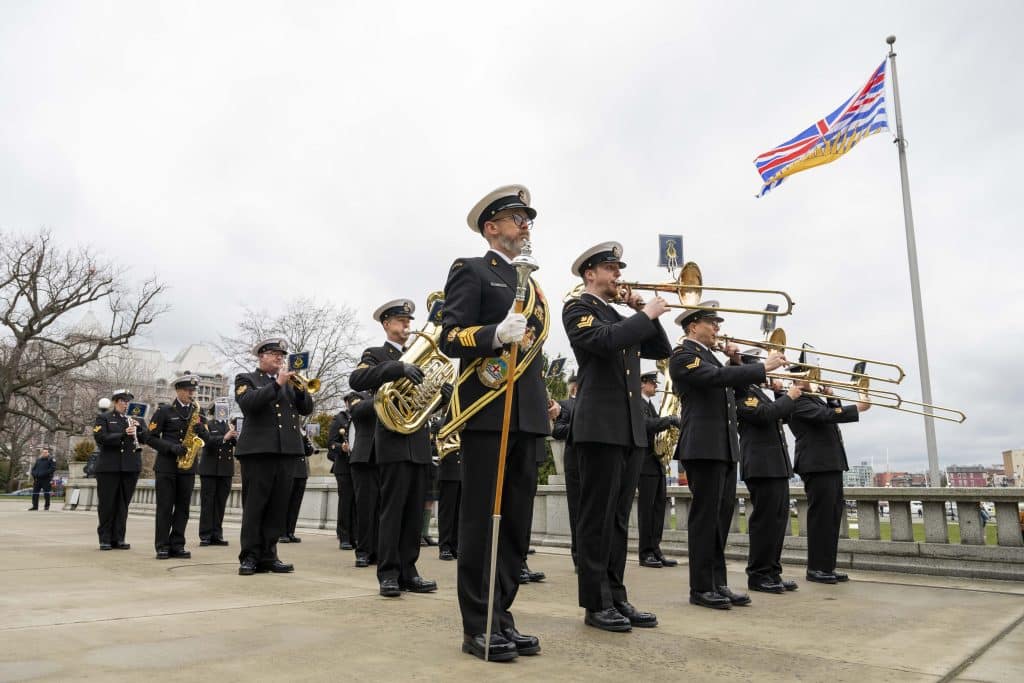
The Naden Band of the Royal Canadian Navy perform alongside Katy Perry during the opening ceremony of the Invictus Games 2025 at BC Place

Rocking the Invictus Games

[caption id="attachment_37091" align="aligncenter" width="597"] The Naden Band of the Royal Canadian Navy perform alongside Katy Perry during the opening ceremony of the Invictus Games 2025 at BC Place, Vancouver, B.C. on Feb. 8. Photo: Corporal Conor R.G. Munn, Canadian Armed Forces Imagery Technician[/caption] The Naden Band performs with Katy Perry at the 2025 Invictus Games Master Sailor Zack Everett The Naden Band of the Royal Canadian Navy  —  The Naden Band experienced some pop stardom last month at the Invictus Games 2025. While performing throughout the week-long event in Vancouver, the opening ceremony on Feb. 8 is something they will not soon forget. “Our band is no stranger to being involved in large ceremonies, but this was on another level,” says Chief Petty Officer 2nd Class (CPO2) Brayden Wise, Unit Chief and Drum Major. “The size of the crowd, the level of talent involved, and the purpose behind it being so important.” The Invictus Games, founded by the Duke of Sussex, are an international sporting competition for ill and injured military members or veterans. The mission of the Games is to honour the people who have come face-to-face with the reality of sacrificing for their country, using the power of sports to help them on their journey of recovery. The Naden Band joined forces with the Royal Canadian Artillery Band from Edmonton and the local reserve band from 15th Field Regiment, an opportunity to join forces with more than the usual 35 band members. The true highlight for every musician this time was working with pop-icon Katy Perry. The grand finale of the opening ceremony involved Katy Perry emerging from within the band, marching right along with them to her hit song, Roar. Breaking into a jog as the bands split in two, her outfit changed colour like a chameleon. Dancers...

A Glorious Breach: PODEX 25 Sails to Success

All photos: Patrol Craft Training Unit vessels performing a formation sail of all 8 training craft during an exercise in the Juan De Fuca straits off of Vancouver Island on Jan. 29. Photos: Sailor First Class Brendan McLoughlin, MARPAC Imaging services. SLt Simon Gonsalves, MARPAC Public Affairs  —  In a Royal Canadian Navy (RCN) first, all eight Orca-class training vessels have successfully sailed together. On the morning of Jan. 29, the eight vessels embarked together from CFB Esquimalt’s Z-Jetty to sail across the harbour in formation. Planned and executed under the title Photographic Orca Deployment Exercise (PODEX) 2025, this was a unique moment in RCN’s recent history. Operated by the Patrol Craft Training Unit (PCTU), these vessels, often simply referred to as Orcas, are designed as a stepping stone to larger, more complicated warships. Able to operate effectively with a small crew complement, these specialized ships provide invaluable practical at-sea training for RCN sailors across a wide range of experiences and expertise. At any given time, it is common practice for one or more Orcas to be unavailable for use while undergoing scheduled maintenance and repairs. However, a rare opportunity arose at PCTU—for a relatively short window, all Orcas were scheduled to be ready and available to sail. Those in charge of the unit decided to take full advantage of this unique opening, planning and executing the first ever PODEX in fine detail.  When asked about the unique opportunity to showcase his unit, Lieutenant-Commander (LCdr) Eric Lashinski, Commanding Officer of PCTU, stated that “it’s just never worked out that we’ve had all of the ships out and available at the same time…to actually get out of the trainer side and come to sea is an amazing opportunity for everybody, it’s genuinely so important.” The fortuitous alignment of ship readiness cycles also...

The Invictus Games 2025: A Celebration of Resilience and Recovery

The DAG Connection — The Invictus Games are coming to Vancouver and Whistler this winter. The idea was first conceived by Prince Harry in 2014 as a celebration of the courage and resilience demonstrated by those recovering from injuries obtained during military service.  The competitive events of the games embody the healing power of sport and community. Through activities like wheelchair rugby and basketball, seated volleyball, and indoor rowing, the Games empower athletes to reclaim their confidence, develop social connections, and regain a sense of belonging. The upcoming games in Vancouver and Whistler will be the first to incorporate adaptive winter sports such as alpine skiing and snowboarding, nordic skiing and biathlon, skeleton, and wheelchair curling. Team Canada will be among the twenty plus nations competing in this year’s events. Comprised of active and retired service personnel from across the Canadian Armed Forces (CAF), each member of Team Canada has sacrificed a piece of their personal wellbeing in the pursuit of our nation’s security. We will have the opportunity to watch as they once again demonstrate their resilience and resolve, pursuing recovery through the unconquerable spirit of the events. By supporting Team Canada at the games, Canadians can honour these athletes sacrifices and inspire their continued journey toward recovery. Invictus Games 2025 serves as a powerful reminder of the strength of our military family, and the resilience of the athletes who inspire us all.     Invictus Out of the night that covers me,  Black as the Pit from pole to pole, I thank whatever gods may be For my unconquerable soul. In the fell clutch of circumstanceI have not winced nor cried aloud. Under the bludgeonings of chance My head is bloody, but unbowed. Beyond this place of wrath and tears Looms but the Horror of the shade,And yet the menace of the years Finds,...

Historic B-Jetty Opening Marks Milestone in Naval Infrastructure Enhancements

[caption id="attachment_36941" align="aligncenter" width="597"] Vice-Admiral Angus Topshee welcomes guests to the B-Jetty Opening Ceremony on Feb. 5.[/caption] Jazmin Holdway with contributions by Leah Pokocky and S1 Robin Kruger Lookout Newspaper  —  In a significant moment for Canada’s Pacific Naval Fleet, the new B-Jetty at HMC Dockyard at CFB Esquimalt was officially opened on Feb. 5, ushering in a new era of capability for the Royal Canadian Navy (RCN). The ribbon-cutting ceremony was attended by dignitaries including the Honourable Harjit S. Sajjan, MP, President of the King’s Privy Council for Canada, Minister of Emergency Preparedness, and Minister responsible for the Pacific Economic Development Agency of Canada, as well as Vice-Admiral (VAdm) Angus Topshee, Commander of the RCN. The opening ceremony featured a ceremonial welcome with the National Anthem performed by the Naden Band. Mr. Paul Schauerte, Acting Director General of Infrastructure and Environment, and VAdm Topshee both delivered addresses acknowledging the immense scale of the project and its positive impact on the Navy’s operations and environmental sustainability. Remarks were kept short in consideration for the freezing temperatures of the morning. [caption id="attachment_36943" align="aligncenter" width="400"] The Honourable Harjit S. Sajjan, MP, addresses the gathering.[/caption] “You don’t just see a ship, you see a massive capability,” said Minister Sajjan while pointing to HMCS Max Bernays, docked alongside the opening ceremony. He discussed the work being done at Maritime Forces Pacific (MARPAC) and the overall capabilities of the RCN, its personnel and supporting infrastructure. The B-Jetty, which replaces the original A- and B-Jetties built during the Second World War, was designed to withstand the challenges posed by climate change and natural disasters, such as tsunamis. Construction on the project began in December 2019, with the achieved initial operational capability date set for November 2024. The 270-meter long and 26-meter-wide marine structure is built on pipe...

The Advanced Naval Capabilities Unit participates in Bold Quest 24 in Jacksonville

Advanced Naval Capabilities Unit Sailors Fly High at Bold Quest 24

Lt(N) R. Davies, Uncrewed System Officer, ANCU  —  From October to November 2024, Advanced Naval Capabilities Unit (ANCU) took part in Bold Quest 24, a significant multinational event hosted by the United States Joint Staff in Jacksonville, North Carolina. This prestigious event brought together approximately 2,000 personnel from 17 different nations, fostering collaboration and enhancing capabilities among allied forces. The ANCU team had three primary missions during the exercise: to integrate into the intelligence cycle of the exercise, participate in a medical demonstration and practical field test of modern medical networking technologies, and support Intelligence, Surveillance, and Reconnaissance operations. To achieve these goals, ANCU deployed a team comprised of an Intelligence officer, a medic and Uncrewed Systems operators flying the CU-175 Puma – a miniature fixed wing Uncrewed Aircraft system used both on land and at sea. One of the standout achievements of the ANCU team during Bold Quest 24 was their support for the first successful execution of the Intelligence Requirement Management and Collection Management (IRM&CM) process using solely Canadian assets through Federated Mission Network (FMN). ANCU sailors played a critical role in providing Full Motion Video (FMV) to the FMN and the Mission Partner Environment. This FMV was subsequently transmitted to the Canadian Forces Maritime Warfare Centre and Trinity in Halifax, marking a significant advancement in the speed and efficiency of intelligence collection and processing. Leading the intelligence efforts, Lieutenant(N) Jeong served as the Naval Intelligence lead for Bold Quest 24, heading a team focused on the practical use of Common Intelligence Picture tools and implementing the IRM&CM cycle. Meanwhile, ANCU’s medic, Master Corporal (MCpl) Patterson, integrated with the Royal Navy and the United States Marine Corps to evaluate the United States Air Force Research Laboratories Battlefield Digital Data Collection Kit (BATDOK), to address medical needs and gather vital...

Year in Review, a look at the Lookout Newspaper’s top stories in 2024

January Pacific Region Surgeon Honoured for Saving Teammate’s Life RCN Honoured in Hockey Day in Canada Festivities CFAD Rocky Point Sends Ammunition Donation to Ukraine A Heartfelt Farewell to 103-year old Major (ret’d) Murray Edwards First Woman Appointed as Chief Boatswain’s Mate   [caption id="attachment_36751" align="aligncenter" width="597"] Members of Victoria's Wong Sheung Kung Fu Club perform a Lion Dance, Feb. 14, at the Canadian Submarine Force Headquarters in Dockyard. Photo: Peter Mallett/Lookout[/caption]   February Combat Divers Return to Metchosin Waters with Exercise Roguish Buoy Trading Places: RCN Ships Complete Hull Swap RCN Sailor Traverses the Antarctic Waters with the Chilean Navy ‘Globetrotting’ Benefits Base Athletes Muggins, the Historic Pooch Remembered and Restored   [caption id="attachment_36754" align="aligncenter" width="597"] Staff Sergeant Daryl Baswick of the Victoria Police Department waves during the Day 2 Woss to Sayward leg of the Wounded Warrior Run BC. Photo: John Penner Photography[/caption]   March Bayleigh Rules as Base Commander for a Day International Day of Forests Highlighting Canadian Rangers’ Role in Protecting B.C.’s Wilderness New Boats for FDU(P) FMFCB Secures New Radar System Dedicated Naval Communicator Named Sailor of the Year   [caption id="attachment_36748" align="aligncenter" width="597"] Teddy, a three-year-old Akita, greets a visitor at the Y-Jetty security gate. Teddy is a therapy dog who helps Commissionaire Bob Cosman. Photo: Bob Cosman[/caption]   April Community Commemorates HMCS Esquimalt Tragedy Langford Pays Tribute to Heroes of Vimy Ridge HMCS Max Bernays Returns Home Y-Jetty Welcomes its Fluffiest Greeter, Teddy Comox Air Show Returns for RCAF Centennial RCN Recognizes Transgender Resilience   [caption id="attachment_36755" align="aligncenter" width="597"] Captain(N) Kevin Whiteside, Canadian Forces Base (CFB) Esquimalt Base Commander, and Chief Petty Officer 1st Class Sue Frisby, CFB Esquimalt Base Chief, march in the parade at Buccaneer Days on May 11. Photo: Master Corporal Nathan Spence, MARPAC Imaging[/caption]   May A Royal Encounter:...

Attend an Employee Assistance Program information session

The Organizational Well-Being program aims to provide you with timely and accessible mental health and well-being services that correspond and evolve with yours and your family members’ needs to enable, educate, and empower you to improve your health and wellness. The Department of National Defence’s Employee Assistance Program (EAP) (you are now leaving Canada.ca, for internal audiences only) is a professional, confidential, and proactive service to support you and your family members with a variety of personal, family, and work-related concerns. Attend an Employee Assistance Program information session to learn more about the new comprehensive range of services and mental health support available for public service employees, including students and casual employees, and their immediate family members. This presentation will cover the following services: Crisis and Short-Term Counselling Life Smart Coaching Digital Mental Health Platform Peer Support Manager Support: Key Person Advice Line (KPAL) Specialized Team Services All information sessions are available in both official languages. Register now for our next session! For more information, contact us at EAP-PAE@forces.gc.ca

A Tale of Two Families Linked by a Naval Sword

[caption id="attachment_36457" align="aligncenter" width="597"] Victoria Colonist report of Oct. 17, 1939 listing Midshipman Peter Piddington as missing. Photo: Paul Seguna[/caption] LCdr (Ret'd) Paul Seguna, CD, CFB Esquimalt Naval & Military Museum  —  The date of the Thanksgiving holiday this year held a special significance in linking the histories of two Vancouver Island families. On Oct. 14, 1939, just over a month after the outbreak of the Second World War, the battleship HMS Royal Oak suddenly sank while at anchor in Scapa Flow – a British fleet anchorage located in the Orkney Islands off the northern tip of Scotland. The ship was the victim of torpedoes fired by the German submarine U-47 in the early morning hours after having penetrated the protected anchorage defences. The battleship capsized within minutes with 835 of the Ship’s Company of 1,234 perishing. Last year, the existence of artifacts from the sinking belonging to the family of James Atwood, a retired Royal Canadian Air Force officer living in Victoria, emerged during a dinner conversation. The items were a naval officer’s sword with scabbard and sword belt given to James’ grandfather in the U.K. after the war by a friend who had been a professional diver and had recovered the items from the ship’s wreckage field. James received the sword and associated items from his grandfather in the 1980s while visiting in England and brought them back to Canada as family heirlooms. After doing some research, James decided the Scapa Flow Museum in Lyness, Scotland should be engaged. The museum subsequently expressed an interest in accepting the artifacts as part of the HMS Royal Oak collection there. Hence, the sword and accoutrements were destined for return to the Orkney’s where they once were the personal possession of an unidentified officer serving in HMS Royal Oak. During the research into the provenance of the sword, another local link arose – Peter Grosvenor Piddington, Midshipman RN, was listed as a casualty and the son of Arthur Grosvenor and Helen Mary...

Bulldogs Away! Mission Success for HMCS Regina

[caption id="attachment_36449" align="aligncenter" width="597"] Group photo of HMCS Regina’s Naval Electronic Sensor Operators and supervising Officer, taken next to one of the ship’s Harpoon missile launchers off the coast of California.[/caption] SLt Simon Gonsalves, MARPAC Public Affairs  —  Under the bright Southern Californian sky, sailors onboard His Majesty’s Canadian Ship (HMCS) Regina participated in Joint Littoral Targeting Exercise 2024 (JoLTEX 24). During this training event, the crew had the rare opportunity to launch two advanced Block II Harpoon missiles soaring over the horizon and far beyond. This live-fire training exercise, conducted in partnership with Canadian Joint Operations Command, was held on Oct. 23 at the United States Navy’s Point Mugu Sea Range, located off the Californian coast near San Diego. This year’s JoLTEX aimed to develop and test targeting processes to enable Royal Canadian Navy ships to strike targets effectively on or near land. The Harpoon missile system, which has a maximum range of 124 kilometres, is the anti-surface missile carried by Canadian frigates, which can quickly engage a variety of surface targets with a high degree of precision. The lessons learned from Regina’s fire-support experience can now be leveraged by other Canadian warships operating in proximity to land. According to Commander Jeremy Samson, the Canadian Patrol Frigate’s Commanding Officer, “HMCS Regina’s precise delivery of surface-to-surface kinetic effects during JoLTEX 24 demonstrates the crew’s commitment to combat readiness and their professional excellence.” When asked about the ship’s performance during the exercise, Commander Samson stated that he “couldn’t be prouder to be part of Regina’s outstanding team and what they’ve accomplished.” However, not everything went according to plan initially—the first Harpoon missile fired by HMCS Regina during JoLTEX 2024 was aborted by American range staff shortly after launch. As safety is paramount during any military live-fire exercise, constant communication is required between the missile and the range facility. After launch, if connection is lost – even temporarily, and for any reason – the range will terminate the missile in flight. HMCS Regina’s...

Vancouver Island Army Reserve Soldier Receives Promotion and Award

  [caption id="attachment_36443" align="aligncenter" width="597"] Campbell River resident Mike Bean, a Master Warrant Officer in The Canadian Scottish Regiment (Princess Mary’s) receives a second clasp to his Canadian Forces’ Decoration from Commanding Officer Lieutenant-Colonel Slade Lerch. The award of the clasp recognizes 32 years of service in the Army Reserve of the Canadian Armed Forces.Photos: Captain Cameron Park, The Canadian Scottish Regiment (Princess Mary’s)[/caption] Captain Cameron Park, Public Affairs Office, The Canadian Scottish Regiment (Princess Mary’s)  —  During a recent ceremony in Nanaimo, B.C. Army Reservist Master Warrant Officer (MWO) Mike Bean of The Canadian Scottish Regiment (Princess Mary’s) was promoted to his current rank by Commanding Officer Lieutenant Colonel (LCol) Slade Lerch. The applause for MWO Bean had barely faded when he was called forward again to receive another significant award –  the second clasp for his Canadian Forces’ Decoration (CD), signifying 32 years of service in the Canadian Armed Forces (CAF). The Canadian Scottish Regiment (Princess Mary’s) is Vancouver Island’s own infantry regiment and a unit in the Army Reserve (ARes) of the CAF. The ARes is a part-time component of the CAF. Like MWO Bean, members of the ARes learn soldier skills in a variety of trades while training one night a week and one weekend a month. Many members of the ARes work full-time for the CAF during the summer months on training courses. Soldiers in the ARes gain many important skills and experiences while also maintaining full time civilian careers.   [caption id="attachment_36444" align="aligncenter" width="597"] Master Warrant Officer Mike Bean (left) is promoted by Lieutenant-Colonel Slade Lerch, Commanding Officer of The Canadian Scottish Regiment (Princess Mary’s). The Canadian Scottish Regiment is Vancouver Island’s own infantry regiment in the Army Reserves of the Canadian Armed Forces.[/caption]

Maritime Explosive Ordnance Disposal High Altitude Mission with Parks Canada

[caption id="attachment_36436" align="aligncenter" width="597"] Petty Officer 2nd Class Paul Paquette inspecting the UXO site on Ross Peak after the successful detonation of the UXO. Photo: Petty Officer 1st Class Burrell[/caption] A/ SLt Patrick Delisle, MARPAC PA  —  As the helicopter climbs above 2,000 metres, two Explosive Ordnance Disposal (EOD) Operators gaze out across the rugged peaks of the Rocky Mountains, the serene beauty in stark contrast with their dangerous mission ahead. For safety, one EOD Tech holds the C4 plastic explosives in his pack, while the other carries the detonators. Soon they will land and begin the precarious task of locating and disposing of the ordnance, ensuring the safety of this majestic environment for future generations. Flying in a helicopter loaded with explosives over a high mountain pass might sound like a scene out of a James Bond movie, but for the Fleet Diving Unit (Pacific)’s (FDU[P]) Maritime Explosive Ordnance Disposal (MEOD) cell, it’s just another Tuesday. But why are highly specialized Navy Divers tasked with blowing up projectiles on the side of a mountain? The answer lies in FDU(P)’s unique responsibilities. This elite team is tasked with disposing military ordnance. Their expertise ensures that even the most challenging and austere locations – whether the bottom of the sea, or the jagged ridges of Glacier National Park – are made safe from the dangers of leftover military explosives. [caption id="attachment_36434" align="aligncenter" width="597"] Image from near the UXO location on Cross Peak. Photo: Petty Officer 1st Class Burrell[/caption] This most recent tasking had them travelling to Revelstoke, B.C. to dispose of two pieces of unexploded ordnance (UXO) from a prior Operation (Op) Palaci found in remote locations at Crossover and Ross Peak, far off the path for all but the most intrepid hiker. Op Palaci is a joint operation with the Canadian Armed Forces (CAF) and Parks Canada Agency (PCA) in Rogers Pass, B.C., with the goal to reduce the risk of naturally occurring avalanches. This is done using precise artillery strikes...

Remembering ‘Whispering Duke’ Schiller Canada’s forgotten aviation hero

Kateryna Bandura, Lookout Contributor  —  A new book in Canadian military history illuminates the extraordinary life of a Canadian aviation pioneer whose daring exploits and contributions to early flight have largely faded from public memory. Tom Douglas’ Whispering Duke Schiller: Canadian Aviation Pioneer resurrects the remarkable story of Clarence Alvin ‘Duke’ Schiller, a man whose aerial feats rivaled those of his more famous contemporaries. Douglas, a veteran journalist and author with a deep passion for Canada’s military heritage, discovered this compelling tale through a personal connection: Duke Schiller was his great-uncle. “I grew up hearing stories about his heroics and escapades but never saw anything about him in print,” Douglas says. Inspired by family lore and armed with a treasure trove of personal documents, Douglas embarked on a journey to uncover the full scope of Schiller’s adventures. The book chronicles Schiller’s life from his family’s roots as Hessian settlers in Ontario to his death-defying exploits as a pilot in the 1920s and 30s. Along this illustrious career, Schiller would pick up nicknames, including ‘Whispering Duke’ and ‘Foghorn Duke’ ironic references to the loud, barking voice he had developed due to his father being extremely hard of hearing. One of the most gripping episodes recounts Schiller’s pivotal role in rescuing the crew of The Bremen, the first aircraft to successfully complete a transatlantic flight from east to west. When the plane crashed on remote Greenly Island off Labrador, it was Schiller’s skill and courage that saved the stranded aviators from certain death in the harsh winter conditions. “But those who held the pessimistic view that the fate of the three European fliers would turn out to be only death delayed hadn’t taken into account the aeronautical know-how and steel nerves of one Clarence Alvin ‘Whispering Duke’ Schiller,” Douglas says. Douglas’ research draws on family archives and extensive newspaper records. The story tells of a man who repeatedly risked his life in the name of progress and human compassion. “I was surprised to...

National Addictions Awareness Week 2024

[caption id="attachment_36411" align="aligncenter" width="597"] Health Or Addiction, Two Opposite Ways. Top view of feet with chalk drawing on the asphalt road[/caption]   PSP Health Promotion  —  Forging Connections This year, the Canadian Centre on Substance Use and Addiction (CCSA) National Addictions Awareness Week is from Nov. 24 – 30. The theme for this year’s campaign is “Forging Connections”, emphasizing the power of collaboration in fostering a supportive and understanding environment. Substance use affects individuals, families, and workplaces in profound ways, but by building meaningful connections among peers, leadership, and support services, we can create a strong network that encourages prevention, early intervention, and recovery. We can strengthen these connections by engaging in open dialogue, increasing awareness of available resources, and promoting a culture of compassion. When working together – whether through peer support, leadership mentorship, or partnerships with health services – we can reduce stigma, improve access to care, and support one another in facing the challenges of substance use. Let’s take this opportunity to forge stronger bonds, ensuring everyone has the tools and community they need to thrive. The Addictions-Free Living Working Group of the MARPAC Health & Wellness Strategy is working to drive change here at MARPAC by creating a culture that encourages healthy lifestyle choices and reduces the risk of problems with alcohol, cannabis, gambling, gaming and other potentially harmful substances and behaviours. The working group continues to work towards creating a culture of health and wellness at MARPAC, and encourages members of the Defence Team to visit the CCSA National Addictions Awareness Week website (www.ccsa.ca/national-addictions-awareness-week) for more information, and to seek help and support if you or someone you know is struggling with an addiction or substance abuse.   MYTHS vs FACTS FROM BASE MENTAL HEALTH SERVICES ADDICTIONS CLINICIANS   Myth #1: “Alcohol and cannabis are...

The Tomb of the Unknown Soldier in Ottawa

The universality of sacrifice

[caption id="attachment_36406" align="aligncenter" width="597"] The Tomb of the Unknown Soldier in Ottawa, ON. Photo: Master Warrant Officer (Ret’d) Floyd Powder[/caption] Fardous Hosseiny, President and CEO, The Atlas Institute for Veterans and Families  —  As Remembrance Day approaches, I find myself pondering a new question this year: 'In remembrance, who might be the forgotten?’ Here in Canada, we know that more than 118,000 brave soldiers did not return home to their loved ones throughout our short history as a nation. Canada’s eight Books of Remembrance, which record the names of every Canadian who died in service to our country, are currently displayed at Parliament Hill’s Visitor Welcome Centre in the Room of Remembrance. Veterans Affairs Canada and the Commonwealth War Graves Commission ensures the maintenance of more than 300,000 markers and grave sites of Canadian Armed Forces members here and around the world, including those whose deaths were not directly attributed to service. It is particularly meaningful to know this exists to maintain those that might have fallen into disrepair or where no living relative remain to continue to provide for the upkeep. Whether they lie marked in Flanders, Bény-sur-Mer, Beechwood, or unmarked throughout the world, these are places where valour lies. Their lives and their service must be honoured. Beyond these numbers though there is growing recognition of a number not accounted for — those lost to psychological wounds sustained as a result of service. As conversations become more open and honest about mental health and how this has been a real impact of service, when we lose a former serviceperson (or currently serving member) to suicide, the question many grapple with now is: How do we officially honour those lives? At the Atlas Institute for Veterans and Families, the feedback we hear from our community is that mental health injuries are...

Remembrance reads

As the cooler weather approaches and the rainy days inspire quiet afternoons indoors getting lost in a book, Greater Victoria Public Library’s Margie Thompson has a book list of military-related titles to enjoy this season. Her recommendations are: Nonfiction And No Birds Sang by Farley Mowat A Most Ungentlemanly Way of War: the SOE and the Canadian Connection by Bernd Horn Battle of the Atlantic: Gauntlet to Victory and Dam Busters: Canadian Airmen and the Secret Raid Against Nazi Germany by Ted Barris Failed to Return : Canada’s Bomber Command Sacrifice in the Second World War by Keith Ogilvie Hunt the Bismarck : the Pursuit of Germany’s Most Famous Battleship by Angus Konstam Masters of the Air : America’s Bomber Boys who Fought the Air War Against Nazi Germany by Donald Miller One Day in August: the Untold Story Behind Canada’s Tragedy at Dieppe by David O’ Keefe Rescue at Los Baños: the Most Daring Prison Camp Raid of World War II by Bruce Henderson Rogue heroes : a History of the SAS, Britain’s Secret Special Forces Unit that Sabotaged the Nazis and Changed the Nature of War by Ben Macintyre The Battle of Arnhem: the Deadliest Airborne Operation of World War II by Anthony Beevor The Corvette Navy: True Stories from Canada’s Atlantic War by James Lamb The Ghost Ships of Archangel: the Arctic Voyage that Defied the Nazis by William Geroux The Longest Day: A Bridge too Far; Other World War II Writings by Cornelius Ryan Unsinkable: Five Men and the Indomitable Run of the USS Plunkett by James Sullivan When the Sea Came Alive: an Oral History of D-Day by Garrett Graff Fiction Catch-22 Joseph Heller Eye of the Needle by Ken Follett The Commodore by Peter Deutermann The English Patient by Michael Ondaatje The Huntress by...

Able Seaman Comrade Allan White: A Legacy of Duty and Humility from the Prairies

[caption id="attachment_36374" align="aligncenter" width="597"] Allan White and members of HMCS Unicorn following the Knight of the Legion of Honour ceremony in Prince Albert, Sask. on Aug. 12. Photos provided.[/caption]   SLt Gokhan Nas, HMCS Unicorn—  At 101 years old, Allan White, a humble yet remarkable man from Saskatchewan, was presented with France’s highest distinction, the Knight of the Legion of Honour, in recognition of his role in the liberation of France during the Second World War while serving in the Royal Canadian Navy (RCN). On Aug. 12, surrounded by friends, family, fellow veterans, and members of His Majesty’s Canadian Ship (HMCS) Unicorn, a solemn ceremony at Mont St. Joseph Home in Prince Albert, Saskatchewan, honoured White’s dedication and courage—a man whose service story continues to inspire. Born in rural Saskatchewan, Allan White wasn’t always destined for naval service. During the war, White made his way to Saskatoon to enlist in the Air Force. However, a last-minute decision would change his course. “I thought, ‘I don’t want to be a prisoner of war,’” White remembered. The idea of being shot down and captured was unsettling. Similarly, he had no interest in the army trenches, muddy and wet from endless days of rain. The Navy, however, held a certain appeal: “As long as your ship is afloat, you’ve got a dry bed—not a bed, but a hammock.” And so, White found himself joining the Royal Canadian Naval Volunteer Reserve (RCNVR). [caption id="attachment_36375" align="aligncenter" width="250"] During the Second World War, Allan White joined the Royal Canadian Naval Volunteer Reserve (RCNVR) at HMCS Unicorn in Saskatoon, Sask.[/caption] White served on several naval ships, but his most notable assignment was aboard the HMS Guysborough. As part of the British 14th Minesweeping Flotilla, the Guysborough played a crucial role in clearing the way for the D-Day invasion. On the fateful nights of June 5 and 6, 1944, White and his comrades swept Channel 2 of the American Sector, ensuring the invasion force’s safe passage. The minesweeping operations...

The Byrnell family while being awarded the Queen Elizabeth II Diamond Jubilee Award.

Esquimalt’s Hidden Heroes: The Byrnell family’s military legacy

[caption id="attachment_36369" align="aligncenter" width="597"] The Byrnell family while being awarded the Queen Elizabeth II Diamond Jubilee Award.[/caption] Kate Bandura, Lookout Contributor  —  Wes Byrnell’s remarkable career spans both military service and pioneering work in sports medicine, leaving an indelible mark on the Canadian Armed Forces (CAF) and the field of athletic therapy. In 1976, Byrnell was awarded the prestigious Order of Military Merit, one of the highest honours in the Canadian military. This recognition underscored his significant contributions to the CAF and his dedication to service. A substantial portion of Byrnell’s military career was spent at Royal Roads Military College, where he trained and mentored young cadets, preparing them for future leadership roles. His impact on the institution was so profound that upon his retirement, he was granted the rare honour of taking the salute on the parade grounds – a privilege typically reserved for commanding officers. “It was usually the commanding officer who would do this, but they made an exception for Dad,” his daughter Carrie Kohan recalls emotionally. “It was a beautiful goodbye from all the cadets and graduates. It still makes me cry that they honoured Dad that way.” Byrnell’s commitment to serving his fellow military personnel didn’t end with his retirement from Royal Roads. He established a sports clinic at CFB Esquimalt’s Naden, where he volunteered extensively, treating personnel from all military branches. This clinic became a testament to his ongoing dedication to the welfare of servicemen and women. At the Naden clinic, Byrnell’s innovative spirit shone through. He introduced groundbreaking hydrotherapy techniques and invented several tools that are still used by athletes today, including the tilt board and the Velcro sock holder, made for soccer players which was used in the 1976 Olympics. His contributions to sports medicine earned him a place in the Victoria and...

S1 Jacob Barrett is presented with the Sailor of the Quarter coin by Commander Sam Patchell

S1 Jacob Barrett Awarded Sailor of the Quarter 

[caption id="attachment_36364" align="aligncenter" width="597"] S1 Jacob Barrett is presented with the Sailor of the Quarter coin by Commander Sam Patchell, Deputy Commander of CANFLTPAC and CPO1 David Bisal, Fleet Chief on Sept. 16.[/caption] Paul Dagonese, Lookout Writer  —  The Royal Canadian Navy (RCN) has named Sailor 1st Class (S1) Jacob Barrett as its Q3 Sailor of the Quarter (SOQ) for the months of July-September. S1 Barrett was presented his award aboard his serving ship, HMCS Max Bernays and presented the coveted SOQ coin from both Commander Sam Patchell, Deputy Commander of Canadian Fleet Pacific and Chief Petty Officer 1st Class David Bisal, Fleet Chief. Chief Petty Officer 2nd Class (CPO2) Jeffrey Maynard nominated Barrett for the award. When asked how he knew Barrett qualified, Maynard said simply, “by popular demand”. “I’m new to Max Bernays, but I quickly figured out how well the whole ship thinks of him as the ‘go-to guy’,” said CPO2 Maynard. S1 Barrett has quite the military resume. He joined RCN as a Marine Engineer in 2015 and completed his Marine Engineer QL3 course shortly after joining. He was then posted to HMCS Ottawa and later HMCS Vancouver. S1 Barrett continued to grow as he earned his Basic Machining Operator Certificate (BMOC) and later posted to HMCS Regina and later, HMCS Yellowknife.  He earned his Marine Engineer QL5 from 2018 to 2020 and was posted to several Kingston-class vessels, where he earned his Engineer Watch Keeper (EWK) Certificate. S1 Barrett helped in the RCN’s coastal transfer of Max Bernays from Halifax to Victoria and has participated in multiple RIMPAC exercises over the years. Now serving on Max Bernays as its EWK, Barrett is surpassing his previous accolades—and his crewmates are taking notice. They’ve seen him consistently dedicating extra volunteer-hours, taking time to train his peers and subordinates,...

Making a mark in memory of Hong Kong veterans

[caption id="attachment_36358" align="aligncenter" width="597"] Hong Kong Veterans Commemorative Association volunteer Derrill Henderson points to the “HK” marker being added to gravestones across Canada, including that of John Levitt, a member of 1st Battalion, The Royal Rifles of Canada Canadian Active Service Force (CASF); in Trenholm, Que.[/caption] A/SLt Taylor Rhuland  —  As Remembrance Day approaches, Canadians prepare to honour those who served, including the often-overlooked heroes of the Second World War Battle of Hong Kong. The journey of ‘C’ Force began Oct. 27, 1941, when troops boarded the AWATEA and the PRINCE ROBERT, traveling through Canada to Hong Kong with brief stops in Honolulu, Hawaii and Manila, the capital of the Philippines. They arrived Nov. 16 but, unfortunately, essential equipment meant for ‘C’ Force was rerouted to Manila and never reached them. In December, around 2,000 Canadian troops engaged in fierce combat against the Imperial Japanese Army. ‘C’ Force included soldiers from the 1st Battalion Royal Rifles of Canada. After 17 days of intense fighting, many Canadians were taken as a prisoner of war (POW) or killed. Derrill Henderson is a passionate advocate for Hong Kong veterans, driven by his family’s military history. His father, Corporal Stewart Henderson, was a POW during the Korean War and rarely spoke of his experiences, motivating Derrill to honour the sacrifices of veterans. Since the mid-1990s, Derrill has played a crucial role in transitioning leadership from the Hong Kong Veterans Association (HKVA) to the Hong Kong Veterans Commemorative Association (HKVCA), empowering veterans’ children to take charge. This shift not only continues to recognize the bravery of these individuals, but also brings fresh perspectives to the association’s mission. Through Derrill’s efforts, many veterans’ gravestones have been located and marked, ensuring their stories endure on the HKVCA website. He has compiled detailed accounts of each veteran’s experiences, including recorded messages from POW camps, preserving their voices for future generations. One veteran who particularly inspired Derrill is Philip Doddridge from New Richmond, Que. Doddridge joined the Army in...

Mr. Jay Hammond recieves a set of wings created using the aluminum of his uncle's recovered Halifax bomber during a Commendation Presentation at 443 Maritime Helicopter Squadron on Oct. 18. Photo: Sailor 3rd Class Jordan Schilstra

A Hero Gets His Wings

[caption id="attachment_36353" align="aligncenter" width="597"] Mr. Jay Hammond receives a set of wings created using the aluminum of his uncle's recovered Halifax bomber during a Commendation Presentation at 443 Maritime Helicopter Squadron on Oct. 18. Photo: Sailor 3rd Class Jordan Schilstra, MARPAC Imaging Services[/caption] Paul Dagonese, Lookout Writer  —  As the Royal Canadian Air Force (RCAF) marks its Centennial year, two exceptional Canadians were celebrated for their significant contributions to Canada’s military history. In a ceremony on Oct. 18 at 443 Maritime Helicopter Squadron in North Saanich, Jay Hammond and Maureen Thom were recognized for their dedication over the past 13 years to find the site where their uncle’s plane went down in the Second World War and exhume the wreckage from seven metres below ground. On May 12, 1944, Halifax Bomber LW682 carrying seven RCAF and one Royal Navy crew members was shot down by a Luftwaffe Messerschmitt Bf 110. The aircraft and its crew perished in the crash. Their remains were submerged in a Belgian marsh for decades. Fifty-three years later, the remains of Hammond’s uncle, Pilot Officer (P/O) Wilbur Boyd “Wib” Bentz, a Canadian bomber pilot, along with two of its crewmembers, Sergeant (Sgt.) J.W. Summerhayes and Sgt. F. Roach, were discovered at their Halifax Bomber’s crash site near Geraardsbergen, Belgium. Lieutenant-Colonel Matt Dukowski, Commanding Officer of 443 Squadron, opened the ceremony by presenting Hammond with a unique tribute from the RCAF, a set of wings (rare for a civilian to receive) crafted from the aluminum of his uncle’s Halifax Bomber. In 2021, the RCAF began using material from the recovered bomber in the wings awarded to all active flight-qualified members. The metal serves as a link between today’s RCAF and the fallen aviators who laid its foundation. Since then, every wing bears the bomber’s tail number inscribed on...

Remembering the Sacrifices of Punjabi-Canadians

A/SLt Josh Grinstead, PAO, MARPAC  —  As Remembrance Day approaches, Canadians reflect on the sacrifices made by those who have served. For Lieutenant (Navy) (Lt(N)) Dhinsa, a Royal Canadian naval officer of Sikh background from Canadian Forces Base (CFB) Esquimalt, this means working on the short film Promises. Directed by Steven Purewal, the movie aims to shed light on the significant contributions of Punjabi forces to the Allied cause during both World Wars—a history often overlooked in mainstream narratives. As a Sikh sailor with a deep family history of military service, Lt(N) Dhinsa’s participation in Promises underscores the importance of remembrance and the need to honour the sacrifices of all who fought for freedom. Promises highlights that many of the soldiers who fought against Axis tyranny during key battles throughout both world wars were Punjabi men from India, who fought valiantly as citizens of the British Empire. The film specifically focuses on the important battles of Neuve Chapple in 1915 and Monte Cassino in 1944, which were largely won by soldiers from the British Raj. Lt(N) Dhinsa expresses a profound sense of responsibility in bringing these stories to light: “The history has been dead for so long; if we if we don’t establish it now, it will be lost.” The director, Steven Purewal, emphasizes the film’s mission to unveil the marginalized histories of Punjabi contributions during the World Wars. “It’s really important for the next generation to see that we’ve come together at important points in our history to accomplish great things,” he states. Purewal wants to create a film that resonates not only with those who know this history, but also with future generations who may be unaware of the sacrifices made by these soldiers in the pursuit of Allied victory. “If we had not been united at that time,...

BreakBeatCode

Unleash Your Creativity: Join BreakBeatCode

A Free Coding Program for Military Teens brought to you by Google Canada! Are you a teen in the military community eager to dive into the world of coding and music? BreakBeatCode is here to help you unleash your inner DJ and coder, offering a unique, free opportunity to learn how to create your very own beats—all by writing code! In this exciting CFMWS Recreation program, you’ll learn the basics of Python, the world's most popular programming language, and use it to build beats that reflect your personal style. With BreakBeatCode, you won’t just be sitting in front of a screen; you’ll be hands-on with a digital audio workstation, a powerful library of sound samples, and a Python interpreter that allows you to bring your musical ideas to life. Python is a versatile language used in tech careers across data science, machine learning, and more, meaning the skills you gain here could serve as a launching pad for your future.   Why Join BreakBeatCode? 1. Hands-On Experience with Real-World Tech  You'll use the same tools and techniques that professionals in music and tech rely on, getting a feel for the tech industry’s fastest-growing field.   This program 2. Learn Valuable Coding Skills  Coding is more than just writing instructions for computers—it’s a way to make your ideas a reality! Python is a highly sought-after skill across industries, and what better way to start learning than through the art of music production? 3. Create Your Own Beats  At BreakBeatCode, your creativity is front and center. Learn to mix, remix, and customize sounds to develop a beat that’s totally your own.  You will have the chance to win amazing prizes from CANEX! 4. Connect with Other Military Teens  Join a community of young military family members, all excited to explore and create...

Caption: Captain (Navy) Kevin Whiteside

A Solemn Tribute to HMCS Kootenay and the Legacy of Remembrance

[caption id="attachment_36334" align="aligncenter" width="597"] Captain(N) Kevin Whiteside, CFB Esquimalt Base Commander lays a wreath at Memorial Park in Esquimalt in honour of those who died during the HMCS Kootenay explosion, accompanied by CPO1 (ret'd) Al Darraugh, who was onboard that fateful day.[/caption] Paul Dagonese, Lookout Writer  —  Members of the Royal Canadian Navy gathered at Memorial Park in Esquimalt on Oct. 23 for a solemn ceremony honouring the nine sailors lost in the 1969 tragedy aboard HMCS Kootenay. The wreath-laying event, marking Canada’s largest peacetime naval loss, drew veterans, sailors, and officials in an act of remembrance. Leading the ceremony was retired Chief Petty Officer 1st Class (CPO1 (ret’d)) Al Darragh who has championed this West Coast tribute, preserving the memory of those who served. “It is through acts of remembrance such as those led by CPO1 (ret’d) Al Darragh, our former Base Chief, who was instrumental in organizing the first of these ceremonies, that the memory of HMCS Kootenay will continue to shape our Navy today,” said Captain Navy (Capt(N)) Kevin Whiteside, CFB Esquimalt Base Commander in his address, thanking Darragh for his efforts. CPO1 (ret’d) Darragh served aboard the Kootenay from 1987 to 1992. As an engineer, he vividly recalls the Kootenay’s harrowing “full power” trial 320 kilometers off the southwest coast of England, during which the ship caught fire and exploded while testing new equipment post-maintenance. The crew bravely battled the flames, ultimately saving the ship and steering it back to England. CPO1 (ret’d) Darragh also took part in a 25th-anniversary re-enactment of the explosion, a tribute that held profound significance. He was on watch as the I/C of the boiler room during the re-enactment at the exact time and location of the blast that struck two and a half decades earlier. “It was somewhat eerie being the...

Explore More

Categories

Featured News

E-Editions Archive

News Stories Archive