
Project FORCE
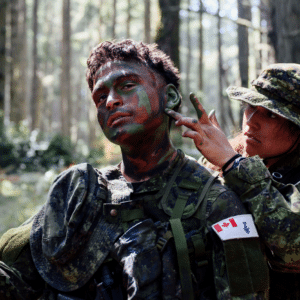
Changes in military fitness standards coming soon. The new tasks are a picket and wire carry, escape to cover, sandbag fortification, causality extraction, a stretcher carry, and a latrine dig.


Changes in military fitness standards coming soon. The new tasks are a picket and wire carry, escape to cover, sandbag fortification, causality extraction, a stretcher carry, and a latrine dig.

[caption id="attachment_1896" align="alignnone" width="300"] Team MARPAC during the 2012 Nijmegen Marches cheers with the crowd as they march through the streets of Groesbeek, Netherlands, during day three of the four-day marches.[/caption] It was blisters and bliss for the Maritime Forces Pacific (MARPAC) contingent when they marched in one of the world’s largest annual pilgrimages. From July 17 – 20, MARPAC’s team joined more than 45,000 military marchers from around the world for the 96th annual Nijmegen March held in The Netherlands. “It was definitely physically challenging for everyone,” said Lt Pam Harris, MARPAC Nijmegen 2012 team leader. “Even with all the training we did it really took a toll on my body doing four days marching that pace.” Each day marchers strapped on a rucksack loaded with 10 kilograms of sand, laced up their combat boots, formed up, and marched, while singing songs to take their minds off the aches and pains. The route was different each day, but always led back to the small village of Nijmegen where the march began in 1916. “It was initially a military incentive to keep military members in shape and was started by the Dutch, but it is now more geared to honour military members who helped liberate that area of Holland during the war,” said Lt Harris. Each night back at the camp marchers soaked their feet, tended to their blisters and prepared for the next day. “We would march for about eight hours a day,” said Lt Harris. “No one complained and everyone interacted with the kids and civilians we met along the way. The team spirit and morale was great. I was very proud of our team. They were amazing.” Nijmegan veterans CPO2 Chris Koblun and Sgt Kim Arnold went as sweepers, supporting the Canadian and British teams when they...

[caption id="attachment_1888" align="alignnone" width="300"] Cdr Bradley Peats of NOTC accepts a donation of 50 hand made quilts from Marilyn Fuller, the Vancouver Island Representative for Quilts of Valour.[/caption] History and valour melded last Saturday at Fort Rodd Hill during Fab Fort, a celebration of Canada’s military. Amidst the howitzers, medieval re-enactors, vintage military vehicles and thousands of visitors, two dozen local quilters delivered 50 hand-made quilts for injured veterans and service members. Accepting the quilts on behalf of the Canadian Forces was Cdr Bradley Peats of the Naval Officer Training Centre. “The CF is like a family. That family isn’t just its active service members,” said Cdr Peats. “It’s our families, civilian organizations, and grassroots organization like Quilts of Valour that do such remarkable things for service men and women.” The women of Quilts of Valour have been stitching these hand-made coverlets since 2006, when the organization was founded by Lezley Zwaal of Edmonton, Alberta. Since then, chapters have sprung up all over Canada and delivered more than 1,500 quilts. The Vancouver Island chapter is headed by Marilyn Fuller, who was on hand to make the Aug. 19 presentation. “We wouldn’t have what we have if the military didn’t do what they do,” said Fuller, who’s had the opportunity to personally deliver quilts to a number of veterans. She says the meetings often ended in tears of happiness. “They just didn’t understand that so many people are appreciative of what they do.” The quilts are created from donated fabric and materials, including two huge boxes of scrap fabric given to Quilts of Valour by Parks Canada. The scrap fabric began as 19th century-style clothing for historic displays and will find new life warming and comforting injured veterans. “Quilts of Valour is very close to what we do at Fort Rodd...

[caption id="attachment_1883" align="alignnone" width="300"] Scan Eagle Unmanned Aerial Vehicle launches from the flight deck of HMCS Charlottetown during Operation Active Endeavour with Standing NATO maritime Group 1 in the Mediterranean Sea.[/caption] In late August, HMCS Charlottetown wrapped up a seven-month deployment and bade farewell to the ScanEagle unmanned aerial vehicle (UAV) detachment that shared the flight deck with Osprey, the Halifax-class frigate’s CH-124 Sea King helicopter. Charlottetown is the first Canadian warship to carry a UAV detachment throughout an expeditionary deployment. UAVs are new to the Canadian Forces — the first was the CU-161 Sperwer, which entered service in Afghanistan in February 2006 — so the skills required to launch, fly, recover and maintain them are still sourced from a variety of military occupations in the Canadian Army, the Royal Canadian Navy and the Royal Canadian Air Force. Because the ScanEagle is still under trial, the Charlottetown UAV detachment included civilian technicians as well as soldiers, sailors and airmen. Integrating and synchronizing all their capabilities required a high degree of collaboration among the UAV detachment’s members. This teamwork produced an exceptional synergy. “Coming from the army, there were certain things that my team and I had to adjust to when operating in a marine environment,” said Sgt Michael Jenkins of the Royal Canadian Artillery, the senior UAV operator and controller in HMCS Charlottetown. “The constant movement of the ship made launch and recovery different from on land, and there was naval lingo and acronyms that we had to learn to be able to operate smoothly with the sailors in the Ops Room.” The Operations Room is the nerve centre of this collaborative effort. Typically, the ship detects a vessel on radar or receives an intelligence report about a “vessel of interest.” Traditionally, a ship reacts in one of two ways:...
DND is stepping up their authority to keep civilians out of the rifle range in Nanaimo. Despite well placed “No Trespassing” signage, people continue to use the DND property as recreation land. The threat of fines and court appearances has garnered the attention of local media and vocal opposition from mountain biking, running and hiking groups who trespass on the federal property along the Westwood Ridge. With safety in mind, DND has placed additional barbed wire fences to keep the public out, and increased patrols. The range has been used by the military, RCMP, the B.C. Rifle Association and other private groups since the 1920s. Two weeks ago, Base Public Affairs officer, Lt(N) Michael McWhinnie met with CTV Vancouver Island at the range to inform the public on this safety issue. “We are asking for a change in the behaviour of specific groups that knowingly trespass upon DND property,” said Lt(N) McWhinnie. “The Nanaimo Range is a restricted access military training area where live ammunition is used, which is clearly identified on regional maps. Any unauthorized access to the property constitutes an illegal act, and it is unsafe.” The military needs to conduct necessary training in an environment that is free of public risk, due to the inherent danger of weapons firing. This eight-kilometre range is licensed to fire up to 7.62 millimetre ammunition from weapons ranging from pistols to machine guns. “Bullets have the ability to travel anywhere in this danger template,” explains MWO Bill Murphy, range control officer for CFB Esquimalt. Situated near the Morrell Nature Sanctuary and Westwood Lake, the Nanaimo Range is a geographically remote area and has been used by civilians as a short cut to the Mount Benson lookout station. “About five or six years ago there was a (one-time only) non-military use agreement signed to have the Nanaimo Mountain Bike Club traverse through our property for a race,” said MWO Murphy. “Since then, it’s become popular to hikers and bikers and they have established...
LS Stephon Mullet of HMCS Vancouver might feel a little chafed when he competes in the Aug. 26 Iron Man Canada Triathlon. The layers of green nylon that form the tutu he’ll be wearing may rub in the wrong places. Triathlons are hard work on the best of days, and a tutu isn’t exactly standard endurance gear. But if LS Mullet meets his fundraising goal of $10,000, he’s pledged to compete in the running and cycling portions of the triathlon in a tutu. It isn’t the first time he’s donned the costume. He wore it for this year’s Times Colonist 10K, as well as the Victoria Triathlon. Why? In support of his charity “Fighting Cancer Below the Belt”, a organization that raises funds and brings awareness to the various forms of gynaecological cancer that affect approximately 80, 000 women world-wide. “My friend’s mom is battling cancer, so I figured I’d wear the tutu for her,” he says. “I’ve lost a friend to cancer in the past, so I want to do what I can to help.” LS Mullet isn’t a stranger to endurance sports. He competed in Iron Man Canada last year, sans tutu. To prepare for this year’s event, LS Mullet trains six days a week for between three and five hours a day. “I’m swimming three days a week, running four days a week and I cycle every day.I’m ready,” he says. Fitness is a priority for LS Mullet, who believes all Canadian Forces members should stay fit. “If I don’t stay fit, I can’t do the job. It helps me keep in fighting shape, and I can help support a great cause.” To donate to LS Mullet’s cause, a donation page can be found on www.uncoverthecure.com Shawn O’Hara, Staff Writer

[caption id="attachment_1828" align="alignnone" width="300"] HMCS Haida, a Tribal-class destroyer built in England, was commissioned into the RCN in 1943, serving in many theatres of operation through the Second World War. After a post-war refit, Haida continued in service through Korean War and Cold War until she was decommissioned in 1963.[/caption] For those who know little or nothing about the Royal Canadian Navy (RCN), stumbling across a vintage warship on the waterfront in Hamilton, Ont., can be a revelation. HMCS Haida, a Tribal-class destroyer built in England, was commissioned into the RCN in 1943, serving in many theatres of operation through the Second World War. After a post-war refit, Haida continued in service through Korean War and Cold War until she was decommissioned in 1963. That year a group of Toronto businessmen formed an organization called Haida Inc and saved her from the scrap yard. The ship was later acquired by the Province of Ontario and moved to Ontario Place in Toronto in 1971. She was designated as a national historic site in 1984 and ownership was transferred to Parks Canada in 2002. Haida was moved to Pier 9 in Hamilton on August 30, 2003, the 60th anniversary of her commissioning. “In our experience, many people who visit the ship have minimal to zero knowledge of Haida or the navy,” says Darryl Jones, past president of Friends of Haida, an organization partnered with Parks Canada and devoted to the preservation of the ship. “When our volunteers inform the public about the history of the ship, her accomplishments and the living conditions aboard, they come away amazed and carry an appreciation of the ship and our navy that they never realized previously.” Haida is now an “irreplaceable historic artifact” managed and presented as a living, operating ship, according to Mr. Jones. Visitors...

[caption id="attachment_1786" align="alignnone" width="300"] OS Dallas O'Dell of HMCS Protecteur hopes to raise enough money so he can rappel down the 13 story CIBC building in downtown Victoria dressed as Boba Fett as a part of the Easter Seals Drop Zone charity event.[/caption] OS Dallas O’Dell plans to trade his Naval Combat Dress for something a little more, or less heroic. On Sept.13, in a patchwork costume resembling the villain Boba Fett of Star Wars, he’ll rappel down the side of the 13 storey CIBC building in downtown Victoria, all in the name of charity. He’ll be doing this as a part of the Easter Seals Drop Zone, an event that raises money to send children with disabilities to summer camp at Shawingan Lake. As a member of the Canadian Forces, OS O’Dell feels it’s important to become involved in the community. “Working with the community is part of our job. It shouldn’t just end at the base,” he says. “I think that Drop Zone is a great cause. I’ll take any chance I can to contribute and be a super hero for a child in need. I think everyone, not just Canadian Forces members, should live by that.” While he admits rappelling down the outside of the towering office building is intimidating, he is just as afraid to not meet his fundraising goal of $1,000, the minimum amount required to participate. “This event is really important to me,” he says. “To put all this effort and thought into it and not meet my goal would be a huge disappointment. It’s for the kids after all.” OS O’Dell is well on his way, having collected more than $300 to date, but he needs more to make the rappel in a quirky costume. To donate, you can contact him directly in...

[caption id="attachment_1763" align="alignnone" width="300"] With a Maritime Coastal Defence Vessel as back drop, command of Coastal Division was passed from Cdr James Sprang to Cdr Lorne Carruth in a change of command ceremony last Wednesday. A congratulatory hand shake sealed the passing of command.[/caption] Coastal Division said goodbye to a fine leader last Wednesday. In a change of command ceremony on Y Jetty, command of Coastal Division was passed from Cdr James Sprang to Cdr Lorne Carruth. Cdr Sprang will become Commanding Officer of HMCS Malahat. At the podium, he addressed the assembled ships companies and reminisced on two years at the helm of Coastal Division. “It feels like just yesterday I was preparing to give the last speech, instead of the first,” says Cdr Sprang. “It has been my privilege to be your Division Commander. I have been humbled by your character and perseverance as you embraced the navy’s motto of ready, aye, ready, and I thank you for your service.” RAdm Peter Ellis, Commander of Canadian Fleet Pacific, was the Reviewing Officer for the ceremony, and took some time to say a few words about Cdr Sprang’s service to the military. “He is a true professional whose dedication to Canada and the navy is inspiring. He’s a great Canadian, and a tremendous leader. We all owe him a debt of gratitude for his leadership and his guidance.” RAdm Ellis then addressed Cdr Carruth, congratulating him on his new postings, and the new phase of his career. “Lorne, you’ve got some huge shoes to fill, but I think you’ve got the focus and the determination to do this job,” he said. “I’m sure under your guidance Coastal Division will continue to grow.” Following the address, the papers were signed, officially relieving Cdr Sprang from the post of Commander of...

[caption id="attachment_1763" align="alignnone" width="300"] An art exhibit opening was held on the top floor of the Maritime Command Museum, show casing (left) Mr. Thomas De Vany Forrestall C.M., O.N.S., B.F.A., LL.D, R.C.A. and the amazing collection of paintings he has contributed to the museum.[/caption] The Maritime Command Museum has a new display of sketches by Annapolis Valley-born artist Tom Forrestall. The sketches are his preliminary work before painting HMCS Assiniboine, a mural-sized image that hangs on a wall in the Wardroom. Forrestall was present for the official opening of the display and, with the assistance of RAdm Dave Gardam, unveiled the focal artwork, an egg tempera painting of Assiniboine in battle with German submarine U-210 in August 1942. Acting museum curator Rick Sanderson thanked the 76-year-old artist for his contribution of sketches. “For me as a curator, it’s important to know the history that these sketches represent,” said Sanderson. “When you look at these sketches, there is a beauty to them. I find it a fascinating look into the mind of an artist.” Each sketch was made in preparation for the mural-sized painting that depicts the painter’s view of a battle at sea. “You have certainly captured the life of the mariner,” said RAdm Gardam. “Everything from the quality of light to the sea state contributes to the realistic and accurate effects. For those of us who have stood on the bridge [of a ship] you have captured our memories with precision.” RAdm Gardam presented Forrestall with a MARLANT Certificate of Appreciation in acknowledgement of his service to the Royal Canadian Navy. In his remarks, Forrestall thanked LCdr (ret’d) Doug Thomas, who acted as a consultant from 2004-05 during the creation of the painting. He also expressed his appreciation for the navy and their support of his...

[caption id="attachment_1702" align="alignleft" width="300"] Ships participating in RIMPAC, Rim of the Pacific Exercise, sail in formation in the waters around the Hawaiian Islands.[/caption] After months of preparation and weeks of training, 25,000 personnel from 22 nations breathed a collective sigh of relief as the Rim of the Pacific Exercise (RIMPAC) 2012 came to an end. Conducted in operating areas on and around the Hawaiian Islands and in the Southern California exercise areas, the world’s largest maritime exercise officially ended Aug. 3. The exercise included more than 1,400 Canadian Navy, Army and Air Force personnel. “I am truly pleased with what we have achieved as part of this exercise,” said Rear Admiral Ron Lloyd, the Deputy Combined Task Force Commander and the senior Canadian participating in the exercise. “The challenging scenarios allowed Canadians and our Pacific Rim partners to develop the skills we will need to work successfully with each other, wherever we may be called upon to deploy.” Royal Canadian Navy participation in the exercise included Her Majesty’s Canadian Ships Algonquin, Ottawa, Brandon, Saskatoon, Victoria and Yellowknife, as well as two teams from the Fleet Diving Unit stationed in Victoria, B.C. The Royal Canadian Air Force provided four CF-140 Aurora Long Range Patrol Aircraft from 14 Wing Greenwood, N.S., and 19 Wing Comox, B.C.; seven CF-188 Hornet fighter jets from 3 Wing Bagotville, Que., with augmentation from 4 Wing Cold Lake, A.B.; and two CH-124 Sea King detachments assigned to Algonquin and Ottawa. The Canadian Army provided more than 122 members from the 2nd Battalion of Princess Patricia’s Canadian Light Infantry (PPCLI) including augmentation from 1 PPCLI, 3 PPCLI, 1 Combat Engineer Regiment and 1 Field Ambulance. Finally, more than 100 members of the Canadian Forces occupied a variety of staff and leadership positions within the exercise. “A...

[caption id="attachment_1697" align="alignleft" width="300"] On 20 July 2012 at Canadian Forces Base Esquimalt Wardroom, Commander Maritime Forces Pacific Rear Admiral Bill Truelove presents the Queen Elizabeth II Diamond Jubilee Medal to Dolly Desjarlais, who accepst the award on behalf of her late husband Leonard "Len" Desjarlais.[/caption] It was an emotional moment for Dolly Desjarlais July 20 when she accepted the Diamond Jubilee medal on behalf of her husband Leonard. Only weeks before, Leonard Harry Desjarlais lost his battle with cancer. He was 80 years old. RAdm Bill Truelove presented the medal to Dolly, Leonard’s wife of 53 years, and Norval, his younger brother, at the Wardroom. “Very few Canadians will be honoured with the Queen’s Diamond Jubilee medal, and Leonard deserved it on many levels,” said RAdm Truelove. “With this medal, we are honouring a great leader, a great Canadian, and a great veteran.” Leonard served in the 3rd Battalion of Princess Patricia’s Canadian Light Infantry from 1951 until 1964. He fought in the Korean War, most notably during the counterattack at the Battle of the Hook in May of 1953. After retiring from active service, he became a member of the Korean Veterans Association of Canada and the National Aboriginal Veterans Association. Last April, Leonard escorted a fallen comrade for burial in Korea. It was this dedication to his comrade, his fellow veterans, and the First Nations communities that earned him the Queen’s Diamond Jubilee medal. In recognition of Queen Elizabeth II’s 60th year on the throne, the Government of Canada unveiled the Diamond Jubilee medal. The medal recognizes significant contributions by Canadians to their communities. Leonard is survived by his wife, Dolly, his children Len Jr, Marvin, Michael, and Corinne. He also leaves behind five grandchildren, Morgan, Graham,...

[caption id="attachment_1690" align="alignleft" width="300"] Sgt Dan Bodden of the Joint Rescue Coordination Centre recently completed a 515 mile bicycle race across Oregon State.[/caption] The human body has limits, but no one seems to have told Sgt Dan Bodden. The search and rescue technician at the Joint Rescue Coordination Centre scratched another high intensity race off his bucket list July 22 when he finished the Race Across Oregon. For two days he rode his bicycle non-stop across the Oregon countryside, racking up 828 kilometres. The bicycle race starts and ends in Hood River, Oregon, and offers up 40,000 feet of vertical climbs through the mountains that dot the state. Sgt Bodden has been competing in endurance sports for almost 20 years. He has completed a number of Ironman Triathlons, and twice the Hawaii Ultraman Triathlon, a three-day event that circumnavigates the Big Island of Hawaii. This particular course was tough, even for him. “There isn’t a lot of flatland. If you’re not ascending, you’re descending. There isn’t a lot of time to rest. You really have to stay alert.” The plan was to complete the race in 36 hours. But the best laid plans can lead to exhaustion, forcing him to extend his time in the saddle into the next evening. “I took a 20 minute nap, but besides that I hadn’t slept, having trained for that. I really suffered that second day, and it obviously slowed me down significantly,” he says. Sleep deprivation lead to hallucinations for most of the second night. “I started seeing animals and people on the side of the road that weren’t there. For a while it was kind of funny, but after a couple hours it really became a problem. I didn’t know what was real.” ...
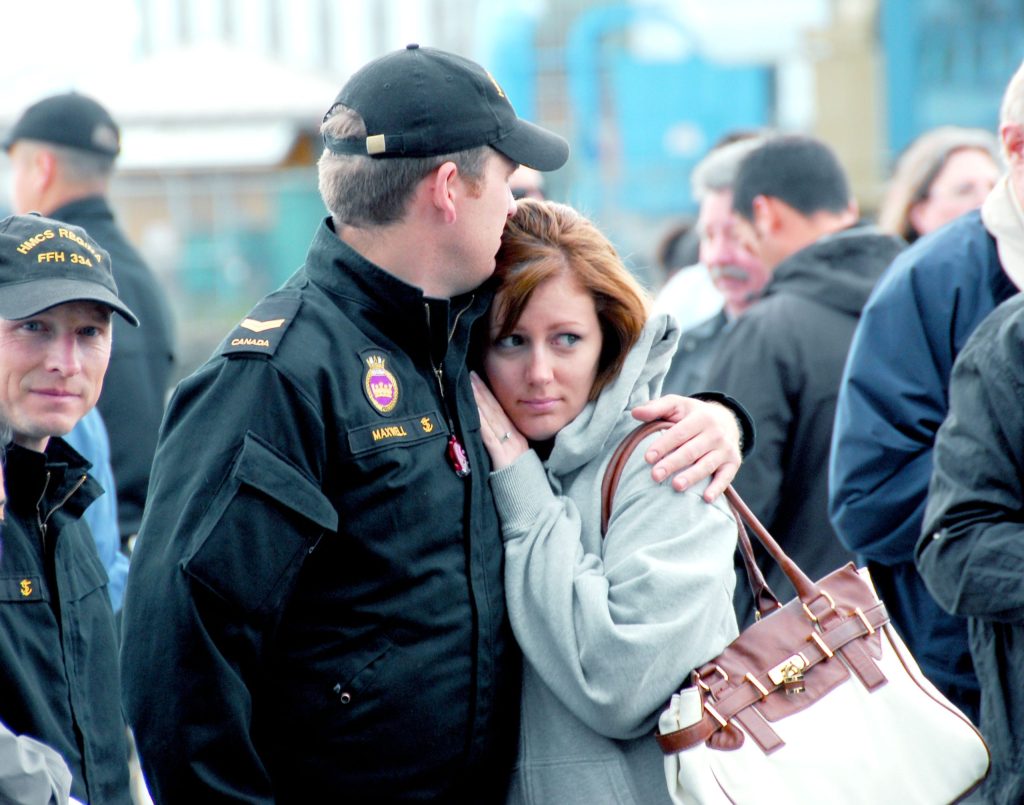
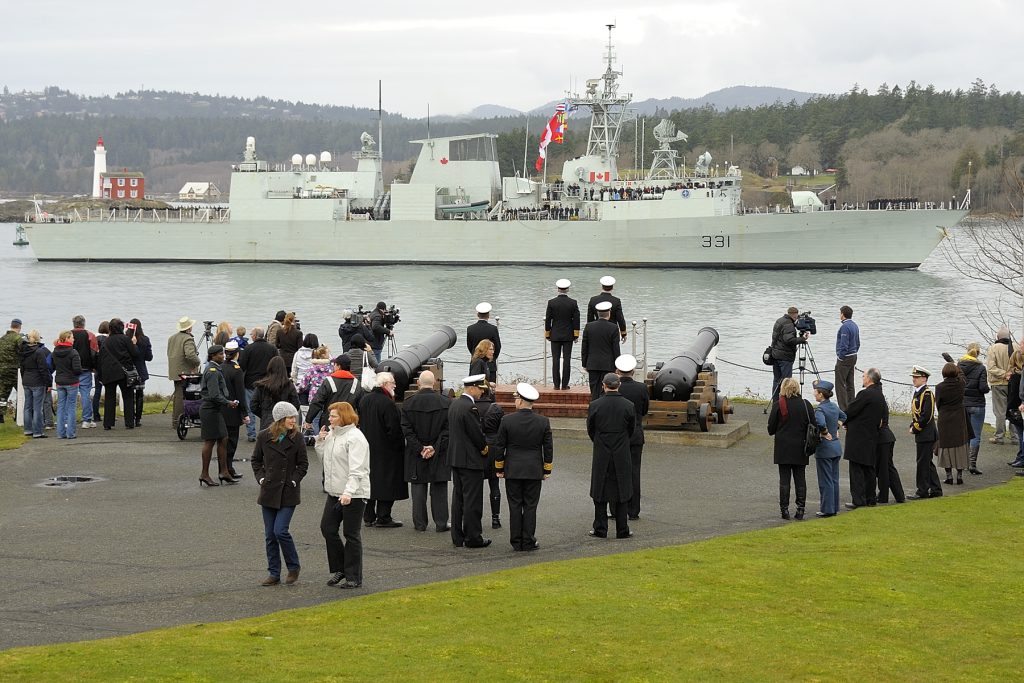
Each military member has his or her own unique way to say “I love you” to the people they leave behind when deployed HMCS Regina Naval Communicator LS Devin Maxwell chose to write 241 love letters to his wife Crystal – one for each day he would be away. Several hours after the ship sailed away on July 3, Crystal learned of her husband’s expression of love and was so touched she decided to share it on “reddit.com”, a social news website where users exchange thoughts on various topics. “I simply couldn’t believe he did this. I was so touched,” she said. “It was such a great surprise and such a sweet story I wanted to share it.” Crystal soon learned about the incredible power of social media. The post went viral and soon after she received an interview request through Reddt.com from a Globe and Mail reporter. The day after it was published there were more than 26 million hits to the website. “I had no idea it would get this big,” admitted Crystal. “I received calls from CTV, Global, CHEK, and Shaw shortly after.” Each wanted to cover the heartfelt story – one example of a couple’s love separated by duty. “I have received a lot of wonderful responses from people online. I believe it is really inspiring people and it made me happy to make them so happy,” said Crystal. Though the overwhelming response has been positive, Crystal has received some negative feedback. “One military spouse expressed resentment at the attention being drawn to Devin’s gesture and said she felt the story diminished the service of the other sailors onboard Regina. Of course this was never the intent and it made me sad that someone would react in this way. I know firsthand how difficult it...
A medical emergency had HMCS Vancouver making a u-turn on its way to Hawaii with HMCS Regina. On July 11, Cdr David Mazur, Commanding Officer of Vancouver, received a report from medical personnel that a crew member was experiencing a serious medical issue. The ship was out of helicopter range, and 1,800 nautical miles away from Hawaii. The captain decided to change course and bring the ship to a destination where “We knew the patient had to get ashore, probably in the next 24 hours or so,” said Cdr Mazur. When the sailor’s condition worsened, extra measures were taken. “It became clear the patient would need potentially life-saving surgery within the next few hours, so we had to find a way to meet search and rescue a lot sooner,” recounts the ship’s captain. Engineers revved up both engines and took manual control. They also drained the ballast tanks to make the ship lighter so it could travel faster. Vancouver rendezvoused with a Comox search and rescue helicopter 240 miles off the shore of Vancouver Island, marking the farthest possible trip by a Cormorant helicopter. The patient was airlifted off of Vancouver at 2:30 a.m. July 12 and taken to Victoria General Hospital for surgery. The sailor was released from hospital two days later. Vancouver won’t be heading back to Hawaii.Cdr Mazur says the display of teamwork between Vancouver’s crew and search and rescue, and getting the crew member to safety was what was important. “It all went very smoothly,” says Cdr Mazur. “The work that was done between the crew, the engineers, and search and rescue made it so we could get the patient the medical attention they required.” Shawn O’Hara, Staff Writer

[caption id="attachment_1636" align="alignleft" width="300"] Base Commander, Capt(N) Bob Auchterlonie; Chris Alexander, Ulrich Suesser and Chief of Staff, Capt(N) Luc Cassivi pose for a photo following a press conference announcing a major project.[/caption] Weather watching just got a boost. Last Tuesday, Chris Alexander, Parliamentary Secretary to Minister of National Defence, announced a $61,980 contract has been awarded to renovate the Meteorological and Oceanographic Centre (METOC) at CFB Esquimalt. Joining him at the Wardroom was Base Commander, Capt (N) Bob Auchterlonie; Chief of Staff, Capt(N) Luc Cassivi; and Officer in Charge of METOC, Ulrich Suesser. Two other bases - CFB Gagetown and CFB Halifax – are being upgraded, collectively part of the $28.1 million Canadian Forces Weather and Oceanographic Service (CFWOS) Transformation Project. “Weather services play a vital role in the operations of our personnel on all three coasts, and on deployments around the world,” said Parliamentary Secretary Alexander. “This project will help to achieve better results for our men and women in the field who depend so heavily on accurate information to make crucial decisions for the safety and security of Canadians. This project will make Canadian Forces weather more centralized, support technology and create a constant global weather watch, and allow us to deliver weather to our commanders on shore and at sea. Having accurate weather reports is especially important for our sailors and search and rescue technicians.” The project includes the construction of a new wing at CFB Gagetown, renovations of the Meteorological and Oceanographic Centres at CFB Esquimalt and CFB Halifax, personnel relocation and the procurement of new information technology systems. Stantec Consulting of Edmonton has been awarded the contract for design work associated with renovations at CFB Esquimalt and CFB Halifax, while the $5.1 million contract for construction of CFB Gagetown’s new wing has been awarded to...
On July 19 during his visit to CFB Esquimalt, The Honourable Peter MacKay, Minister of National Defence unveiled the War of 1812 Commemorative pins which will be worn by all Canadian Forces members for the next three years to mark the sacrifice and commitment of those who fought in this war from 1812-1815. He pinned the first one on Sailor of the Quarter LS Mathieu Blais during a ceremony held on the Wardroom patio. The 1812 Commemorative banner was also unveiled which will be flown by Canadian Forces units, formations and establishments across the country. “This tribute will be a daily reminder of a key chapter in Canada’s history, and of the courageous efforts made by the regular and militia soldiers, provincial marine and the aboriginal allies who helped define who we are today,” said Minister MacKay. “Alongside our Government’s commitment to support the men and women of the Canadian Forces for the challenges of the future, we have made important progress in preserving and promoting the history of those who served in years past.” The War of 1812 was instrumental in the development of Canada’s military and tells the story of the Canada we know today – an independent and free country in a constitutional monarchy with its own parliamentary system. French and English speaking Canadians fought and defended Canada alongside First Nations members during the War of 1812. “Canadian Forces members across the world can proudly wear their pin and fly their banners as, much like their ancestors, they proudly serve Canada by defending its values, interests and sovereignty.” As part of its initiative to commemorate the 200th anniversary of the War of 1812, DND created the CF War of 1812 Commemorative Banner which will be presented to CF units, formations, and establishments whose heritage embraces service in the defence of Canada during 1812-1815. The banner will be carried, flown, or displayed throughout the 2012-2015 commemorative period and paraded thereafter by units, formations, and establishments on anniversaries of...
The majority of boxes have been unpacked in the Admiral’s house and RAdm Bill Truelove is settling into his corner office at D100 with a view of Esquimalt Harbour and the task at hand – commanding Maritime Forces Pacific (MARPAC) and Joint Task Force Pacific (JTFP). “It’s incredible to be back here,” he said staring out his window. “It’s been five years since we were on this coast and we are thrilled to be back among these folks and this exciting team.” Late last year from his post in Kabul, Afghanistan, RAdm Truelove learned his next post would be in Victoria where he would assume the responsibilities of Commander of MARPAC and JTFP. “Getting this appointment was a thrill for me. It is both exciting and daunting to a degree as it is a significant posting. When I received official word I was incredibly honoured and humbled by the announcement,” he said. RAdm Truelove began his career at Royal Roads military college and he met his wife Brenda on a blind date in Victoria. “We got married in front of the castle at Royal Roads and Victoria is home for Brenda, so she is very happy to be back,” he said. “We both have a lot of history here and it’s nice to see familiar faces.” RAdm Truelove grew up a “navy brat”. His father served 36 years and attained the rank of Chief Petty Officer. “My dad has always taught me the critical role that our chiefs, petty officers and leaders play in the navy. I grew up seeing him go away a lot and we moved every few years and now I have done that with my children. My daughter reminded me once that it was 12 schools in 13 years and it struck home with me that we can never thank our families enough for what they do to support us,” he said. RAdm Truelove’s daughter Ashley is a nanny in Switzerland, while his son Anthony is...
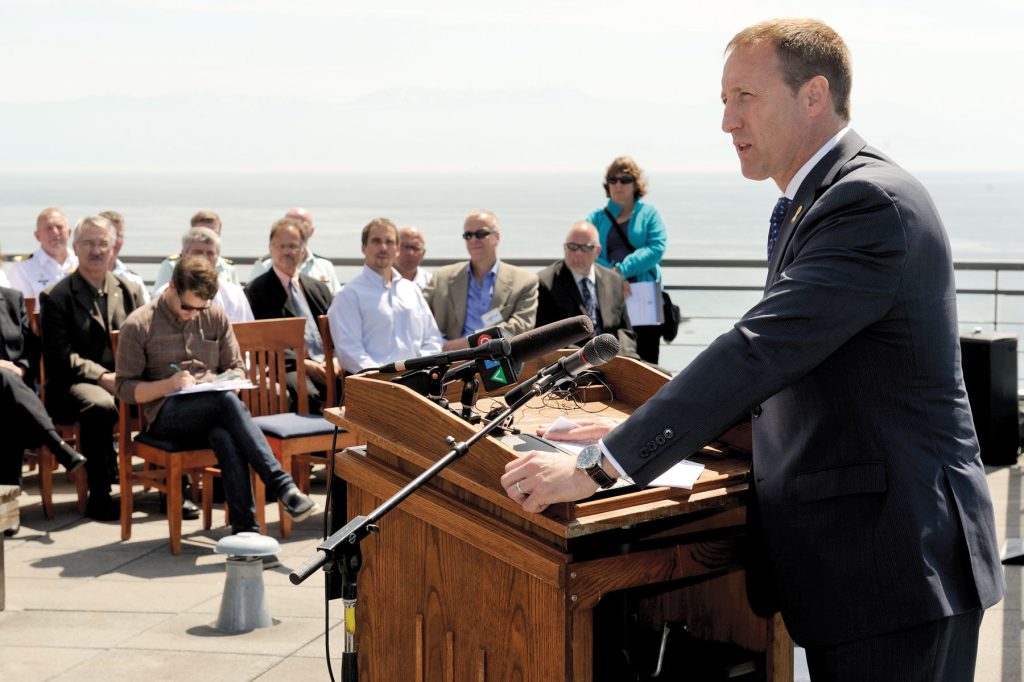
Four contract awards for Department of National Defence and Canadian Forces related infrastructure projects which total $10.9 million were announced last Thursday by Minister MacKay during his visit to CFB Esquimalt. The four projects including replacing obsolete electrical equipment at Canadian Forces Ammunition Depot Rocky Point, outfitting the Canadian Towed Array Sonar System block, repairs to A-Jetty, and the replacement of transformers at the Canadian Forces Fleet School. “The Government of Canada is determined to provide modern, efficient and effective infrastructure for our Canadian Forces personnel. I am pleased to show continued progress on these goals, which is in line with our commitment to give our men and women in uniform the support they need so they are fully prepared when the call to action comes,” said Minister MacKay. “These projects also provide the economy with important local jobs,” he said. Rocky Point’s Ammunition Depot upgrade to their electrical and communications systems includes the installation of a new electrical grid including feeder lines, distribution panels and transformers to magazines and improved lighting. G&E Contracting was awarded the $5.8 million contract. The Canadian Towed Array Sonar System block is a 1,600 square meter extension to Fleet Maintenance Facility’s Dockyard 250 which houses the new combat/electronic work centre. This work centre will include the units responsible for the maintenance and repair efforts conducted on all electronic ship systems, such as communications, radar and electronic warfare sensor equipment. The contract involves outfitting this facility with the electrical, mechanical architectural and industrial shop support features required for the functions that will be found within the building. Ledcor Construction has been awarded the $2.9 million contract. A-jetty’s structural repair involves the replacement deteriorated piles, bracing, timbers and other key structural members. RUSKIN Construction won this $1.1 million contract for services. Canadian Forces Fleet School’s transformer...

[caption id="attachment_1510" align="alignnone" width="300"] Base Commander Capt(N) Bob Auchterlonie assumed command from Capt(N) Craig Baines during the Change of Command Ceremony held in Naden’s Parade Square. The change of command cermony was administered by RAdm Bill Truelove (centre).[/caption] Friends, family, and colleagues gathered last Thursday to bid farewell to a great leader – Capt(N) Craig Baines - and warmly welcome the new head of CFB Esquimalt. In a Change of Command ceremony held on Museum Square, Capt(N) Baines passed on the responsibilities of Base Commander to Capt(N) Bob Auchterlonie. The ceremony was attended by dignitaries from surrounding municipalities and communities, including Esquimalt mayor Barbara Desjardins and representatives of the Esquimalt and Salish First Nations, Chief Andy Thomas, Elder Mary Anne Thomas and Elder Elmer George. “While I am happy to pass on the reasonability of command, this day is also bittersweet,” said Capt(N) Baines. “Having command is a bit like playing poker, with the mission as the pot. Luckily for me I was dealt a hand of aces. One of those aces is every man and woman, civilian and military, of CFB Esquimalt. For all that you’ve done in these past few years, I would like to personally thank you.” Capt(N) Baines expressed in excitement and respect for Capt(N) Auchterlonie, and the comfort with which he turns over command. “He is a man of tremendous experience and professionalism, and I’m excited to see where we’re going, and how we’re going to get there,” he said before the turnover. “I can’t tell you what a pleasure it is to turn command over to such a great friend and know that all the great work the men and women of CFB Esquimalt do will continue under his watch.” Following his speech, he joined Capt(N) Auchterlonie and RAdm Truelove in signing over command....

[caption id="attachment_1504" align="alignnone" width="300"] Command of the Base Construction Engineering (BCE) branch changed hands July 11 when outgoing Commanding Officer Col Darlene Quinn said goodbye to colleagues and friends and LCol Matthew Johnsen took the reign.[/caption] After two years as Commanding Officer of Base Construction Engineering (BCE), Col Darlene Quinn stepped down July 11. Taking her place is LCol Matt Johnsen. Below, Col Quinn reflects on her service at CE. Describe the highlights of your time in this position. I became Commanding Officer (CO) of the Base Construction Engineering Branch in July 2010. On the technical side, some of the highlights have been growing our infrastructure maintenance program to a level that will make tangible inroads in improving the condition of our infrastructure, as well as seeing the progress of the major capital program. On the leadership side, without doubt my highlight has been watching the individual people in the Branch stretch themselves to new levels, take on new skills and responsibilities and fulfill every major challenge thrown their way. On a professional level, I have enjoyed broadening my infrastructure knowledge to include navy-specific infrastructure such as the jetties, the dry dock, and the oily waste water treatment plant. In the past, I have served as BCEO for both the army and for the air force. This has been my first experience with the navy and I have thoroughly enjoyed it. What will you miss most about this post? I will miss the pace of activity. Engineering at this level is exhilarating because it is such a fast paced and rapidly changing environment. What is next for you? I will be moving to Ottawa to take up the post of Director General Military Engineering (DGME). DGME is Associate Deputy Minister Infrastructure and Environment’s (ADM(IE) lead for capital construction,...
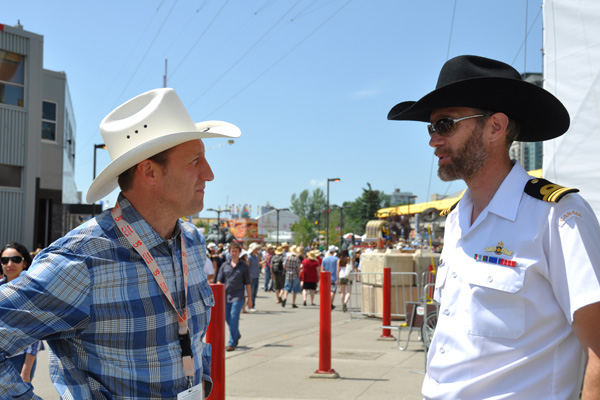
[caption id="attachment_1500" align="alignnone" width="300"] The Honourable Peter Mackay, Minister of National Defence (left), discusses the submarine HMCS Chicoutimi with its Commanding Officer, LCdr Andy Cooper.[/caption] Sailors from HMCS Calgary and the submarine HMCS Chicoutimi saddled up this past weekend to join soldiers and airmen and women participating in the 100th Anniversary of the Calgary Stampede. Calgary sailors make an appearance every year to coincide with their annual Namesake City visit. The “Greatest Outdoor Show on Earth” kicked off at 9 a.m. Friday, July 6 with the Stampede parade, where fireworks and a Snowbirds flypast signalled the beginning. More than 300,000 people lined the streets to watch the parade, which included the colourful heraldry of marching bands from all over the world, over one hundred floats, horse teams, cultural displays, and military contingents. All three elements were represented in the parade. The Naden Band of Maritime Forces Pacific led sailors from Calgary, Chicoutimi, and Tecumseh, Calgary’s naval reserve unit. They were followed by members of 1 Canadian Mechanized Brigade Group (1 CMBG), a Leopard tank, and Coyote with crew. The Royal Canadian Air Force (RCAF) banner flew before a marching contingent of airmen and women and the Cold Lake Band. Each contingent took up the length of an entire city block, drawing applause and standing ovations as they passed. At the Stampede Grounds, static displays from all three elements are set up to encourage interest and curiosity from the general public. Children play in the Rigid-hulled inflatable boat (RHIB) supplied by HMCS Tecumseh, clamour into a G-Wagon, sit in an F-18 cockpit and straddle the saddle on Chicoutimi’s MK 48 torpedo. The displays are very popular and well attended, but none so much as the Explosive Ordnance Disposal robot, which draws many smiles and nervous laughter when it unexpectedly follows people...
Ammo tech among first four civilians deployed to Afghanistan.

[caption id="attachment_1398" align="alignnone" width="300"] CFB Esquimalt received the first of three new firetrucks designed and engineered to last the next 25 years.[/caption] CFB Esquimalt Fire Department recently received a custom-built 2012 Class A Pump Fire Truck, one of three trucks being purchased over the next two years to replace CFB Esquimalt’s aging fleet of fire fighting apparatus. The truck was designed specifically for CFB Esquimalt firefighters, with the unique situations found in fighting fires on a naval base in mind. The truck sports a smaller water tank and a side-mounted control panel that makes the vehicle lighter and shorter over all, and allows it to travel across jetties safely. Increased hose storage and a pumping volume of 2,000 gallons a minute enhances the mobility and power needed to respond to fires aboard ships and the large buildings found within CFB Esquimalt. Safety was also a focus in the design. The cab of the truck can withstand a roll over, protecting the controls as well as fire fighters. There are also systems in place that ensure seatbelts are fastened and doors closed. Tom Mehmel of Fort Garry Fire Trucks says the design specifications are intended to make the jobs of CFB Esquimalt’s Fire Department easier and most importantly safer. “The most important thing is protecting the fire fighters,” says Mehmel. “This isn’t a backyard creation. The safety systems that are in place are there to protect the lives of the fire fighters and the general public on the way to a call.” Rick LeQuesne, Deputy Fire Chief at the CFB Esquimalt Fire Department, reviewed the truck design, and offered suggestions based on what CFB Esquimalt’s fire fighters need to do their jobs. He says one of the main strengths of the vehicle is its versatility and adaptability. “The vehicle has a...

[caption id="attachment_1392" align="alignnone" width="300"] Lt Iphigenia Morales on board the American naval hospital ship USNS Mercy working as a staff nurse.[/caption] Canadian Forces nurse Lt Iphigenia Morales is getting the training opportunity of a lifetime. She’s currently on board the Amercian naval hospital ship USNS Mercy working as a staff nurse. The noncombatant ship is part of the UN Pacific Partnership 12, a humanitarian and civic assistance mission to Indonesia, the Philippines, Vietnam and Cambodia. It left on a four-and-a-half month humanitarian journey May 3 from San Diego, and is crewed by 70 civil service mariners working for Military Sealift Command, who operate and navigate the ship while navy planners and medical personnel plan and execute the mission. Japanese landing ship tank Oosumi, carrying a complete medical team, helicopters and representatives from Japanese volunteer organizations, will join Mercy during its stops in the Philippines and Vietnam. The 28-year-old nurse from Canadian Forces Health Services (Pacific) has joined the Medical Surgery Ward, helping prepare and assist pre- and post-surgery patients. Upon hearing of the ship’s arrival, people begin lining up on the jetty in the wee hours of the morning waiting to be ferried to the ship. The civil service mariners operate two 33-foot utility boats to transport patients and mission personnel between ship’s anchorage and shore. Mercy is too large to pull pier side at any of the mission stops. The operation of these small boats, which carry more than twice as many passengers as Mercy’s two embarked helicopters, greatly increase the number of people who will benefit from the mission. “Lines of more than 500 patients begin forming at three in the morning, waiting for the clinic to open, and yet the people remain positive and excited to interact with us,” says Lt Morales. In Sangihe, Indonesia, she...

[caption id="attachment_1386" align="alignnone" width="300"] LS Sean Hemeon, with MS Ryan Russell (inset), both weapons technicians, help unload the Close In Weapons System on board HMCS Charlottetown.[/caption] Weapons for fighting, radar for detection and navigation, the horizon-reference system that helps the Sea King helicopter land safely — all these systems are under the care of the Combat Systems Engineering (CSE) Department, which handles much of the crucial maintenance involved in keeping a ship combat-ready at sea. One piece of kit aboard HMCS Charlottetown is all too familiar to the members of the CSE Department: the Mk 15 PHALANX 20-mm Close-In Weapon System, abbreviated “CIWS”, known to most as the Sea Whiz. The ship’s last ditch defence mechanism, the CIWS is a radar-guided six-barrelled Gatling-type gun system that fires bursts or continuously at either 3,000 or 4,500 rounds per minute. It is located on top of the ship’s hangar to engage fast-moving close-range targets such as diving missiles and aircraft, and attacking gun-boats. If this powerful machine is to be ready to defend the ship, the CSE Department members must perform “the upload.” “Whether it’s five degrees in the middle of the Atlantic Ocean in winter, or a scorching 35 degrees in the Mediterranean, this thing’s got to be ready to go at all times,” says LS Matthew Martin, a weapons technician serving in Charlottetown. The call comes across the CSE “meet-me” net: “All on-watch CSE personnel muster CSE flats, CIWS upload.” It takes two minutes for the required personnel to get into their jackets and leather-palmed gloves. Within 10 minutes, everyone is already beginning the task, with MS Kelly Spicer and LS Timothy Tyler preparing the ammunition in a compartment immediately under the gun mount, and the rest of the group at work on the hangar roof. To ensure its complex...

[caption id="attachment_1350" align="alignnone" width="300"] The crew of NOTC Venture rides the Big Bike for charity.[/caption] At 39 years old the last thing I ever thought my spouse Blaise and I would face was the news that he needed open heart surgery in order to replace his mitral valve. Leading up to the day we were told of his condition, life seemed fairly normal. The kids had gone back to school and Blaise started to experience some flu-like symptoms. He just thought they had brought home the latest virus and he was the next victim. This went on for a few days and through some coaxing I finally talked him into going to the hospital to get checked out. Less than 24 hours later he was told he had endocarditis, which, as was explained to us, is inflammation of the inside lining of the heart chambers and heart valves. Two weeks in the Jubilee Hospital, and six weeks of home antibiotic therapy later the impact of the endocarditis and infection was known and surgery was scheduled. The support of the amazing doctors involved and the information that was made available to us from the Heart and Stroke Foundation truly got us through this period of our lives, and Blaise is doing great. Fast forward to a few months ago when the advertisement for this year’s Heart and Stroke - Big Bike Challenge caught my eye. Who couldn’t have fun with 29 people on a bike, riding through downtown Victoria. With promotional package in hand I approached our Executive Officer, LCdr Ryan Klassen who agreed without hesitation to become the Team Leader. His brilliant mind at work, the team name “BLogged Arteries” was conceived. This was our first year in this event and the team raised $1,763.10 for this very worthwhile...

[caption id="attachment_1346" align="alignnone" width="300"] As a recipient of the Star of Military Valour, Sergeant Jeremy Pinchin, SMV, listens to The Decorated inaugural speech given by the Chief of Defence Staff, General Walter Natynczyk.[/caption] A new initiative called The Decorated Programme was unveiled June 14 in Ottawa. It aims to increase awareness of the outstanding achievements of decorated CF members. The Decorated recognizes the bravest of the brave: those who display the ultimate example of devotion to duty in the presence of the enemy, or who willingly and knowingly place themselves in harm’s way to save or protect others. This initiative is being promoted a number of ways. An exhibit featuring portraits and citations of highly decorated CF members is presently situated in the National Capital Region until the end of June, and will travel throughout the country to various bases in the fall and early next year. The Decorated website has been launched and features military valour and bravery decoration recipients dating back to 2001, and other related news. Also, news stories on decorated CF members will be featured in upcoming issues of The Maple Leaf. “Canadian Forces members have always, and will continue to exemplify a set of military values that are dear to us all: duty, loyalty, integrity and courage,” says Chief of the Defence Staff General Walt Natynczyk while unveiling The Decorated programme in Ottawa. “The Canadian Forces members celebrated within The Decorated represent the very best qualities of all those who serve, whether it be in battle or while helping those in need.” To learn more about the decorated CF members featured within The Decorated program, please visit the Defence Team website at http://dt-ed.mil.ca/ Corporate Internal Communications

[caption id="attachment_1341" align="alignnone" width="300"] Counter-piracy. On April 26, 2009 a member of the Naval Boarding Party stands watch as Her Majesty's Canadian Ship (HMCS) Winnipeg participates in an SNMG1 port visit to Karachi Pakistan to increase awareness of NATO activities in the region.[/caption] Royal Roads University, the Asia Pacific Center for Security Studies, and Maritime Forces Pacific will be holding the biennial Maritime Security Challenges conference in Victoria, B.C. from Oct 1-3, 2012 Women have made tremendous strides in the United States Armed Forces; however, many still seek further equality in the realm of combat operations. In February, the Pentagon opened up 14,000 positions for servicewomen that were previously unavailable to them, marking a milestone that will see females in roles such as intelligence officers, tank mechanics, and rocket launcher crew members. While there are still approximately 255,000 combat-related roles that women are prohibited from participating in, the nature of modern warfare has distorted the concept of front lines, ensuring that every person deployed to a warzone, male or female, has the potential to become involved in combat. The unbalanced differentiation between the U.S. military and the adversaries they face in combat zones in Afghanistan and Iraq have forced insurgent groups to confront American and allied forces in irregular ways, which have made non-combat roles extremely dangerous. The threat of suicide bombings, improvised explosive devices, and ambush tactics carried out by guerrillas disguised as allied security forces have all been evident in countless instances. This challenge of unconventional warfare has increased the demand for more combat-ready troops, and has led the U.S. military to allow women to be attached to battle units. Although women cannot officially participate in U.S. infantry or special forces operations, they are still regularly subject to warfare dangers through attachment to combat groups in supporting roles...

[caption id="attachment_1268" align="alignnone" width="300"] PO2 Matthew Grady gives the order to unveil the HMCS Huron Screw Monument at the Military Museums on June 3, in Calgary, Alberta.[/caption] Naval veterans and dignitaries gathered Sunday June 3 for the unveiling of HMCS Huron’s port screw. Also on hand were member of the public, as the unveiling coincided with Armed Forces Day at the Military Museums in Calgary, Alberta. The 17-foot, five blade variable-pitch port screw was shipped in eight parts from Esquimalt to Calgary by Arthur Hazle, and then cleaned using a high-pressure water jet by Murray Hazle. Don Connolly, Gary Hansen, Jack Pidgeon, Gord Rowan and Andy Madsen then hand buffed all the surfaces and applied a clear coat to prevent future discoloration. The unveiling ceremony took place outside the Naval Museum of Alberta. Lieutenant-Governor Donald S. Ethell, Member of Parliament Rob Anders, and Calgary Deputy Mayor Diane Colley-Urquhart each spoke before Rear-Admiral Mark Norman, Deputy to the Commander of the RCN, ordered the unveiling. The monument is dedicated to “the men and women who served in the boiler and engine rooms of the ships of the RCN in the 20th century.” A good number of these engine room artificers and stokers were on hand for the ceremony. Scott Hausberg, Contributor