Pacific Navy News
Red Dress Day with Movement is Medicine
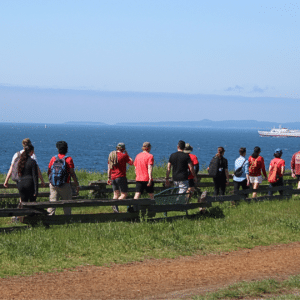
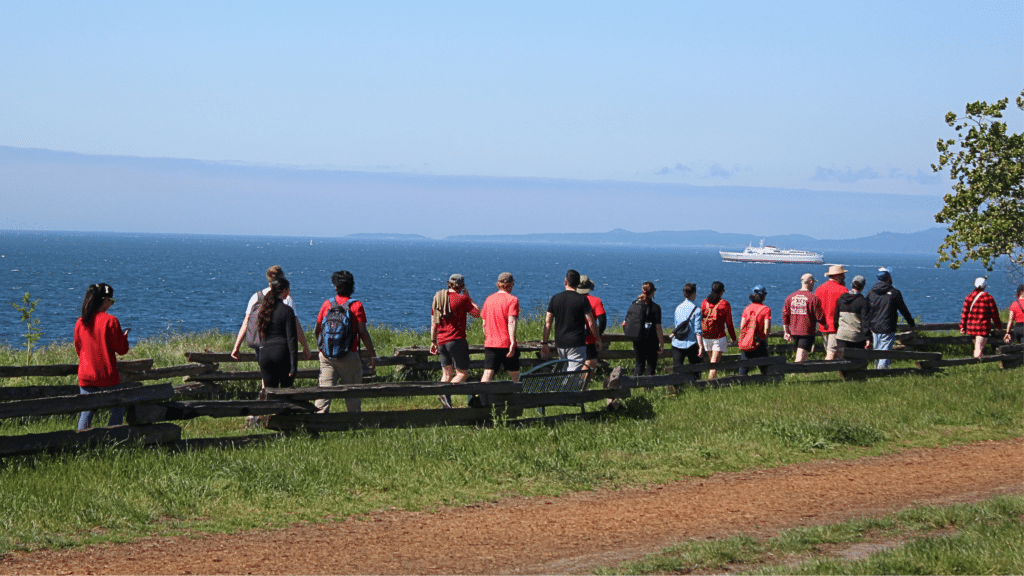
Lindsay Groves, Lookout Newspaper. Defence Team members and community allies gathered at Clover Point for Red Dress Day in solidarity with MMIWG2S+ awareness. The event emphasized healing through movement, reflection, and community connection under the theme “Movement is Medicine.” - At Clover Point on May 5, members and allies of the Indigenous Community and the Defence Team gathered for the event, “Movement is Medicine,” in recognition of Red Dress Day — the National Day of Awareness for Missing and Murdered Indigenous Women, Girls, and 2SLGBTQIA+ people (MMIWG2S+). This event, coordinated by Caitlin Hancock of Fleet Maintenance Facility (FMF), aimed to raise awareness of MMIWG2S+, support the effort to end gendered and racialized violence against Indigenous peoples, and encourage healing, reflection, and community support. Participants were invited to wear red, walk, run, or wheel in solidarity. Sergeant (Sgt) Nate (Nathan) Spence, a member of the Sandy Bay First Nation in Manitoba (Man.) and the Military Co-Chair of the Pacific region's Defence Indigenous Advisory Group (DIAG), opened the event with a land acknowledgement spoken in his Anishinaabemowin language. He then shared his own deep connection to Red Dress Day. “For me, this movement is not abstract,” he said. “It is not symbolic. It is personal.” His aunt, Charlene Ward-Lake, was murdered on Nov 1, 2007 — “a day forever engraved in my mind, my heart, and my soul,” Sgt Spence shared. He continued to share how the violence of that day did not end with her passing. It flowed through her loved ones, leaving Ward-Lake’s daughters without their mother and her grandchildren without their grandmother. Those left behind are now without Ward-Lake’s “laughter, her warmth, and the joy she brought,” Sgt Spence said. Instead, her family is left “with an absence that cannot be filled.” Sgt Spence continued, saying that within...
“Peace Did Not Come Easily”: Remembering the Battle of the Atlantic
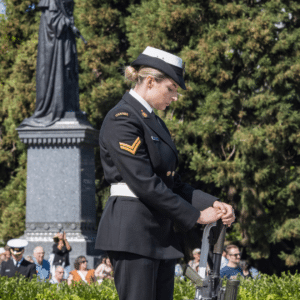
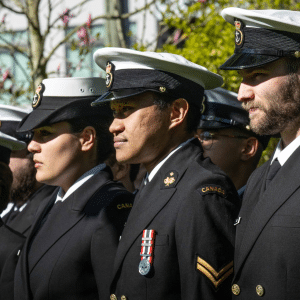
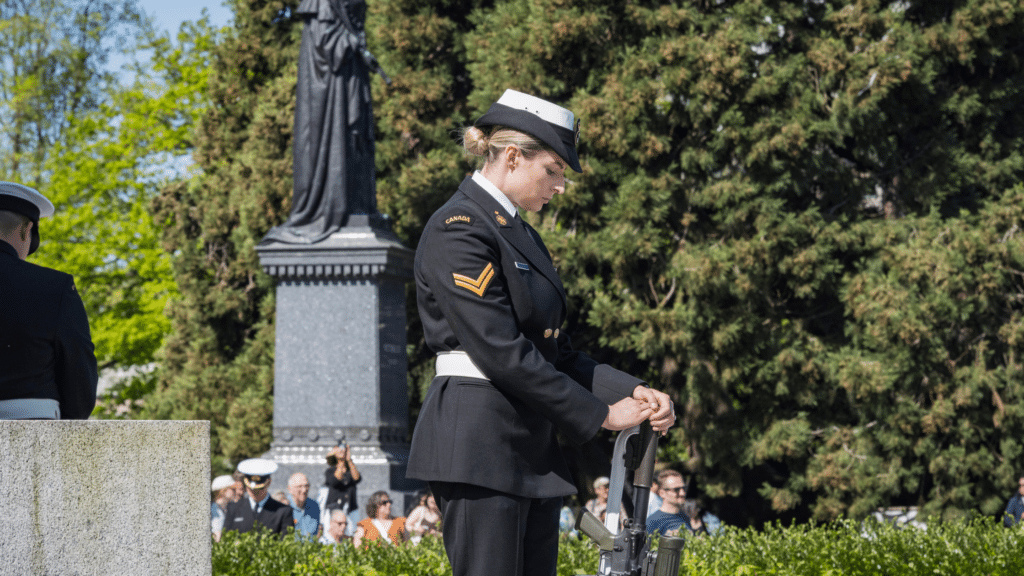
Archana Cini, Lookout Newspaper. Contributions by the Naval Association of Canada Defence members, veterans, and civilians gathered at the B.C. Legislature for the annual Battle of the Atlantic remembrance ceremony. RAdm David Patchell reflected on the endurance, sacrifice, and vigilance required during the Second World War. The ceremony connected the legacy of wartime service to today’s evolving maritime security environment. - Beneath clear skies at the British Columbia (B.C.) Legislature, Defence Team members, their families, veterans, and civilians gathered for the Battle of the Atlantic remembrance ceremony. Held annually on the first Sunday in May, the ceremony commemorated the thousands of Canadians who served during the longest continuous campaign of the Second World War — nearly six years of conflict at sea. [caption id="attachment_336179" align="alignleft" width="600"] Members of the RCN salute during the Battle of the Atlantic remembrance ceremony held on May 3. Photo: MS Bryan Underwood, MARPAC Imaging[/caption] Over the course of the conflict, the Royal Canadian Navy (RCN) helped escort thousands of convoys across the Atlantic, protecting vital supply lines between North America and Europe from German U-boat attacks. Addressing attendees during the ceremony, Rear-Admiral (RAdm) David Patchell, Commander of Maritime Forces Pacific/Joint Task Force Pacific (MARPAC/JTF(P)), reflected on both the sacrifice and fortitude of the campaign. “The Battle of the Atlantic was a campaign defined not by single moments, but by unrelenting endurance and quiet courage,” said RAdm Patchell. “It was fought across a vast, unforgiving ocean, far from the public eye, where danger was constant and reassurance was scarce.” Today, the RCN is credited with destroying 33 U-boats and 42 surface ships through the end of the war, by which time more than 110,000 Canadians had taken part in the campaign. However, the cost of the war was immense. The Navy lost 34 vessels and more than 2,000 sailors, while the Royal...
On Remembrance and Continuity: What Happened After the Sinking of HMCS Esquimalt in 1945
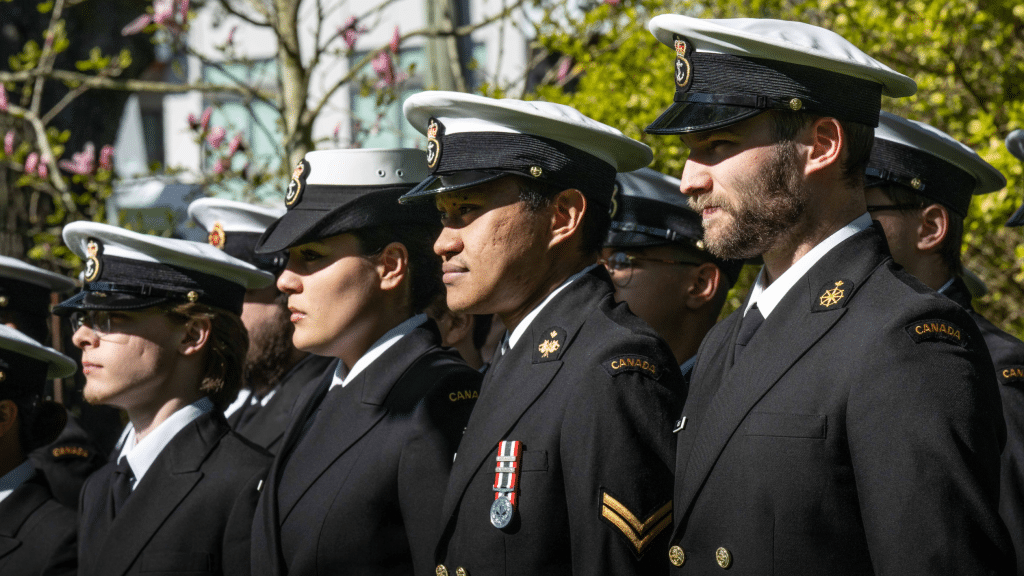
Archana Cini, Lookout Newspaper. An annual memorial ceremony marks 81 years since the sinking of HMCS Esquimalt and honours 44 sailors lost. Story highlights what followed the tragedy, including U-190’s capture and role in Canadian naval training. Powerful examples of reconciliation show how remembrance often extends beyond loss and into shared humanity and legacy. - Almost 81 years after His Majesty’s Canadian Ship (HMCS) Esquimalt sunk within sight of the Canadian shoreline, members of the Defence community, local leadership, and island residents gathered in the Township of Esquimalt to remember the ship’s crew and reflect on something larger than the tragedy alone. The annual ceremony marked the sinking of the Bangor-class minesweeper, torpedoed by the German submarine U-190 on April 16, 1945 — just weeks before the end of the Second World War in Europe. Captain(Navy) (Capt(Navy)) Kevin Whiteside, Commander of Canadian Forces Base (CFB) Esquimalt, shared that the ceremony remains one of the most meaningful events he attends. “This is one of my favourite ceremonies to be a part of because of how much it means to this township, and this base,” said Capt(Navy) Whiteside. “Though the events of 1945 grow distant in time, their meaning does not.” [caption id="attachment_335984" align="alignright" width="450"] Captain(Navy) Kevin Whiteside, Commander of CFB Esquimalt, speaks during the HMCS Esquimalt memorial ceremony held on April 16.Photo: Cpl Conor R.G. Munn, CAF Imagery[/caption] Mayor Barbara Desjardins, who has spoken at the annual remembrance ceremony for the past 18 years, emphasized the deep connection between the Township of Esquimalt and the vessel that carried its name. “The loss of HMCS Esquimalt is significant to the township, not only because she shares our name, but because we recognize the sacrifice and the loss of those who served on her,” she said. “Behind each of these men lost were families; wives, sons, daughters, parents, friends, and...
Engineers win Beaver Cup in a Thrilling Overtime Hockey Game
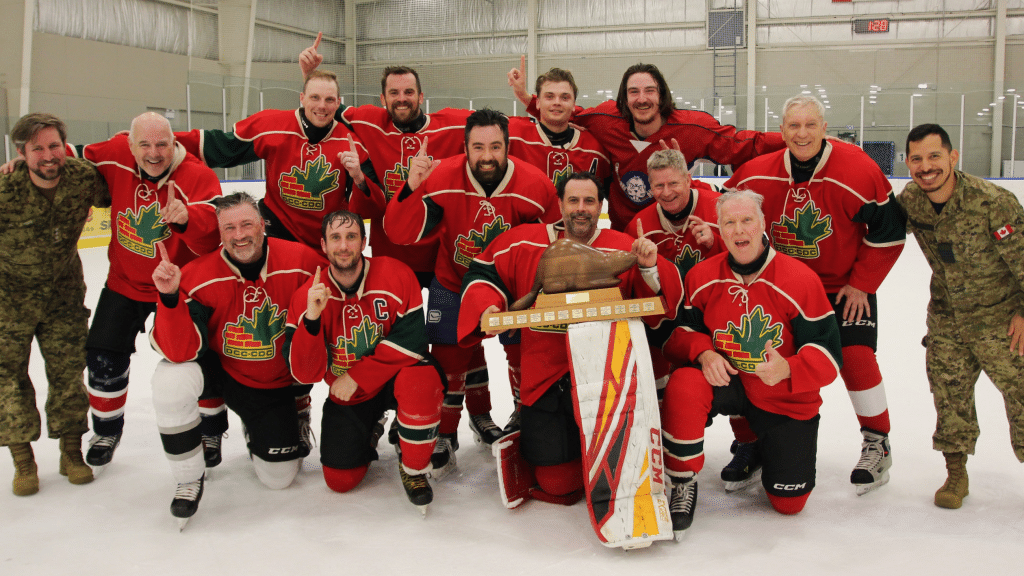
Archana Cini, Lookout Newspaper. Contributions by Master Warrant Officer Robert James Kerr, Real Property Operations The Engineers defeated the Bandits 4–3 in a thrilling overtime final to win the 2026 Beaver Cup. The tournament has united military members, veterans, and civilians for over 50 years of tradition. - Competition, camaraderie, and overtime action took over Wurtele Arena as Canadian Forces Base (CFB) Esquimalt hosted the annual Beaver Cup hockey tournament from April 22 to 24. Four teams, including the Bandits, Engineers, Sappers, and Pioneers, took to the ice in a tournament built on connection as much as competition. Players consisted of Real Property Operations (RP Ops) personnel; active and retired Military Engineers; and members from other units, mixed across the four teams. “The Beaver Cup hockey tournament was originally initiated in order to maintain espirit de corps,” said Master Warrant Officer (MWO) Robert James Kerr, who noted that the tournament has existed for more than 50 years. “It initially started in the 1970s in Eastern Canada, and in the mid-80s out west.” From 1996 to 2019, CFB Esquimalt and CFB Comox alternated hosting duties every second year. Since the pandemic, the tournament has been held solely in Esquimalt since 2024. This year’s iteration of the tournament featured two days of round-robin play, with each team playing four games. The scores concluded with the Bandits topping the standings, followed by the Engineers, Sappers, and Pioneers. This set the stage for Friday’s medal games. In the championship game, the Engineers defeated the Bandits in overtime to claim the Beaver Cup title 4-3. [caption id="attachment_335970" align="aligncenter" width="828"] Beaver Cup champions, the Engineers (in red), and runner-up team, the Bandits (in black), pose for a group photo on April 24. Photo: Krista Morgan[/caption] “With a goal waved off in the final minutes of the third period, the finals...


MARPAC Health & Wellness – Weekly Water Fun
May 20, 2026

Community Musical Jam
May 20, 2026
MARPAC Health & Wellness – Weekly Water Fun
May 27, 2026
CFB Esquimalt: A Historic Naval Base Anchoring Canada’s West Coast
Located just west of Victoria, British Columbia, CFB Esquimalt is a historic naval base and home to Canada’s Pacific Fleet. As one of the largest military installations in Canada, it plays a vital role in supporting maritime operations, fostering economic growth, and serving the community with a range of services and facilities.
Contact the Lookout Newspaper
"*" indicates required fields
Share Your Navy Story
Do you have a story about life at CFB Esquimalt or experiences with Canada’s Navy? We’d love to hear from you! Share your unique perspective and contribute to preserving the legacy of our naval community.